
Introduction
5S implementation looks deceptively simple on paper: five words, five steps, a tidy warehouse. In practice, it's one of the more disruptive projects a facility can take on.
It touches layouts, inventory records, employee habits, and accountability at the same time. Many teams start with good intentions and a weekend of cleaning, only to watch clutter and confusion creep back within a month.
A realistic implementation team includes:
- Warehouse managers and supervisors who own the daily workflow
- Frontline employees who know where the real bottlenecks live
- Maintenance teams responsible for equipment and racking
- Inventory specialists managing locations and counts
- Process-improvement leaders coordinating Lean or Six Sigma work
Skip a phase, and old problems resurface: misplaced inventory, wasted travel time, hidden safety hazards, inconsistent work methods across shifts, and rework nobody traces back to its source.
This guide covers the five standards, how to prepare a pilot area, how to implement each phase, and how to validate and sustain the results.
Key Takeaways
- 5S is Sort, Set in Order, Shine, Standardize, and Sustain, with Safety often added as a sixth standard.
- A baseline assessment and a defined pilot zone beat a warehouse-wide overhaul on day one.
- Employee involvement, visual controls, documented standards, and regular audits make gains last.
- Barcode and inventory software connect locations to records but do not replace operating standards.
The Five Warehouse Standards, Explained
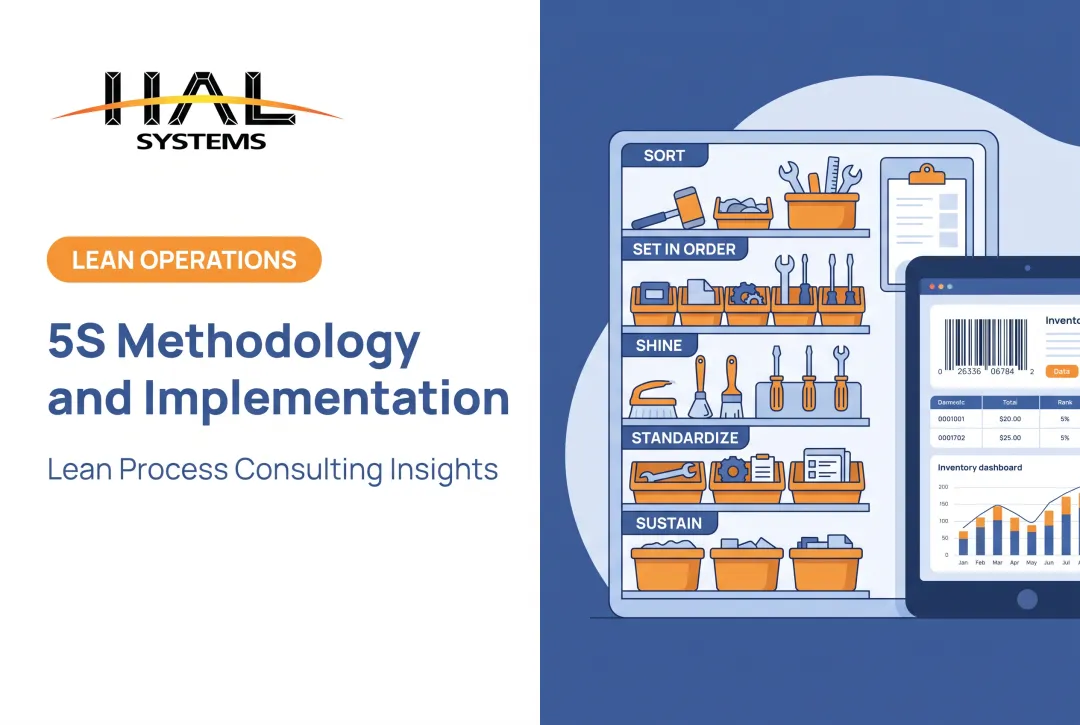
According to ASQ's five-S tutorial, the five standards are Sort, Set in Order, Shine, Standardize, and Sustain. In a warehouse, each one solves a distinct operational problem:
| Standard | Core Action | Warehouse Outcome |
|---|---|---|
| Sort | Remove what you don't need | Frees floor space, cuts search time |
| Set in Order | Give every item a home | Reduces travel, speeds picking |
| Shine | Clean to inspect | Surfaces leaks, damage, and wear early |
| Standardize | Document the best method | Keeps performance consistent across shifts |
| Sustain | Maintain the standard | Prevents backsliding |
Sort and Set in Order in Practice
Sort means identifying obsolete, damaged, duplicate, excess, and misplaced inventory or equipment. Use a red-tag area with a named owner and a disposition deadline. Don't just relocate the clutter to another corner.
Set in Order means assigning locations based on:
- Velocity, weight, and size
- Handling requirements and FIFO rotation
- Ergonomic reach and replenishment flow
- Clear separation between pedestrian and vehicle routes
Shine, Standardize, and Sustain Work Together
Shine goes beyond appearance. Assign cleaning ownership and schedules that expose leaks, damaged racks, worn equipment, and packaging failures that need escalation, not just a dust-free floor.
Standardize means documenting location conventions, labeling rules, cleaning standards, replenishment limits, and a defined response when conditions slip.
Sustain is how supervisors and operators keep the first four standards alive through routine audits, layered accountability, corrective-action tracking, and periodic review as SKU velocity shifts.

Safety belongs in every one of these phases, not bolted on at the end as a checklist item.
Where 5S Fits With Lean, Kaizen, and Six Sigma
- 5S organizes the work area and makes problems visible.
- Kaizen builds on that foundation with incremental improvements.
- Six Sigma tackles statistically complex defect problems that go well beyond organization.
5S doesn't replace these methods. It creates the stable, visible conditions they need to actually work.
Prerequisites and Safety Considerations
Before anyone moves a pallet, confirm these starting conditions:
- Leadership sponsorship with real authority to approve layout and process changes
- A cross-functional implementation team — supervisors, operators, maintenance, inventory specialists
- A clearly defined pilot zone, not the entire warehouse
- Baseline observations and photographs of current conditions
- Time budgeted for training and follow-up, not just the kickoff event
Safety Requirements You Can't Skip
US warehouses operate under OSHA obligations that exist independent of any 5S project. Build these into the plan from day one:
- Keep aisles clear, in good repair, and appropriately marked for mechanical handling equipment, per OSHA's materials handling standard
- Maintain exit routes at least 28 inches wide, visible, marked, and free of stored materials
- Separate pedestrian and equipment traffic with walkways, barriers, or floor striping where barriers aren't practical
- Complete a written PPE hazard assessment
- Stack tiered bags, containers, and bundles so they're blocked, interlocked, and height-limited against collapse
- Label chemical containers correctly and keep safety data sheets accessible
Verify current requirements against OSHA guidance and any applicable local codes before finalizing layout changes. Rules get updated, and site conditions vary.
When to Stop the Work
Pause implementation and get qualified review if you encounter:
- Unsafe or overloaded racking
- Blocked emergency exits or fire equipment
- Unidentified hazardous materials
- Unstable loads
- Layout changes proposed without engineering or safety sign-off
Tools and Resources Required
Keep the resource list practical. You need:
- Red-tag materials, labels, and barcode or location identifiers
- Floor-marking tape and signage
- Cleaning and inspection tools
- A camera for before-and-after documentation
- Zone maps, SOP templates, and audit forms
Essential tools are visual controls and documentation: labels, maps, and written standards everyone can reference. Optional tools, like shadow boards, digital checklists, dashboards, or mobile scanning devices, add convenience but aren't required to get started.
One point gets overlooked constantly: barcode and inventory systems need updating whenever locations, item identities, units of measure, or replenishment rules change.
A receipt posted against the wrong unit of measure can throw a count off by multiples of that unit. Shipping the correct part against the wrong sales-order line creates two separate inventory errors at once. Relabeling a bin without fixing the underlying transaction doesn't solve anything; it just hides the problem behind a cleaner-looking label.
How to Implement 5S in a Warehouse
Follow these steps, in sequence, for a pilot that actually holds up:
- Assess the current state. Walk the warehouse with frontline employees, photograph representative conditions, and map material and information flow. Document search and travel problems, and establish baseline measures such as picking accuracy, inventory discrepancies, space usage, or corrective-action closure time.
- Build the implementation plan. Choose a pilot zone, define the business problem and desired outcome, assign owners, and set review dates. Decide upfront how red-tagged items will be dispositioned.
- Run the pilot through all five phases. Complete Sort, Set in Order (physical and digital), Shine, Standardize, and Sustain in the pilot zone before expanding. LEI's Menlo case study shows the same pattern: associate-led red-tag teams, floor striping and location signage, and monthly conformance checks run by the people doing the work.
- Train and involve the workforce. Explain the reason behind each change using photographs from your own floor. Invite operators to flag wasted motion or unsafe conditions, and train every shift, not just the one in the room during kickoff.
- Connect physical changes to operational systems. Update warehouse locations, item records, barcode labels, replenishment rules, and cycle-count procedures so the system matches the floor. This is where pilots often fail: a bin gets relabeled, but nobody updates the location record, and the next scan errors out. Configurable warehouse software such as HAL Traxx can support this step by tying barcode-driven location data to receiving, picking, and reporting. The software only performs as well as the process it is configured to follow.
- Validate before you expand. Confirm items can be found and returned correctly, safety and visual standards hold, and your chosen performance measures moved in the right direction. Replicate only what worked.

What to Check Before Calling It Done
Visual checks:
- Clear aisles and stable storage
- Consistent labels and defined homes for tools and inventory
- Clean equipment and accessible safety resources
- No unresolved red tags
Functional checks:
- Receiving, putaway, picking, and replenishment
- Returns, cycle counting, and WIP movement
- System transactions working against the new standard, not just looking right
A warehouse can look spotless and still have inaccurate records, impractical slotting, or standards that break under peak volume. Validate before you scale.
Common Implementation Problems and Fixes
Most 5S failures trace back to a handful of repeat offenders:
| Problem | Why It Happens | Fix |
|---|---|---|
| Treating 5S as a one-time cleanup | No ownership, standards, or follow-up | Assign zone owners, schedule checks, review corrective actions |
| Changing layout without updating data | Moves aren't recorded in labels, maps, or systems | Require transaction, label, map, and system updates as one change |
| Standards built without employee input | Impractical locations or unclear labels invite workarounds | Use operator-led design reviews, pilot testing, feedback loops |
| Auditing without acting on findings | Repeated observations erode trust in the program | Assign owners, due dates, root-cause analysis, escalation rules |
None of these fixes are complicated. They just require someone to actually own the follow-through, which is usually the step that gets dropped once the initial excitement fades.
Pro Tips for Implementing 5S Effectively
- Start with a visible, manageable pilot tied to a real operational problem, then use documented results and employee feedback to build support for expansion.
- Make standards visual (photographs, floor markings, color conventions, location labels, shadow boards) so a new hire understands them without a verbal walkthrough.
- Review standards whenever SKU velocity, equipment, staffing, or customer requirements change. Build seasonal demand and new product introductions into that review cycle.
- Combine daily ownership with periodic leadership audits. For multi-warehouse rollouts, complex workflows, or system integration, HAL Systems' Lean/Six Sigma consulting (led by an ASQ Certified Six Sigma Black Belt) can support the work.
Conclusion
Warehouse 5S succeeds when it's treated as a management system for making problems visible, not a cleaning or rearrangement exercise. Build momentum in a clear sequence:
- Establish a baseline before changing anything
- Involve the people actually doing the work
- Pilot changes in one zone first
- Update physical and digital records together
- Validate each standard before expanding further
Configurable inventory and warehouse technology, including HAL Traxx, can support that visibility and continuous improvement, but only when it's aligned with clearly defined 5S processes rather than used to automate whatever inefficiencies already exist.
Frequently Asked Questions
What are the 5S standards for warehouses?
Sort, Set in Order, Shine, Standardize, and Sustain. Many organizations add Safety as a sixth standard, though it should be embedded throughout rather than treated as a separate final step.
What are the steps to 5S implementation?
Assess current conditions, plan a pilot zone, involve employees, run the pilot through all five phases, document the standard, audit regularly, act on corrective actions, and expand only what worked.
What is the purpose of 5S in a warehouse?
5S improves visibility, organization, and safety while making inconsistent work methods and abnormal conditions easier to spot. It's a foundation for detecting waste, not just a tidiness program.
How do you sustain 5S in a warehouse?
Assign clear ownership, maintain visual standards, train every shift, run routine audits, and close out corrective actions quickly. Continuous improvement should be part of the review, not an afterthought.
Can small warehouses implement 5S?
Yes. 5S scales down to stockrooms, parts areas, manufacturing stores, and tool rooms. Adjust the scope to the available space and workforce, but keep all five standards intact.
How do you measure the success of a 5S warehouse implementation?
Start with a baseline, then track relevant measures such as search time, picking accuracy, inventory discrepancies, space usage, safety observations, and corrective-action closure rates. Avoid promising universal targets since conditions vary by site.