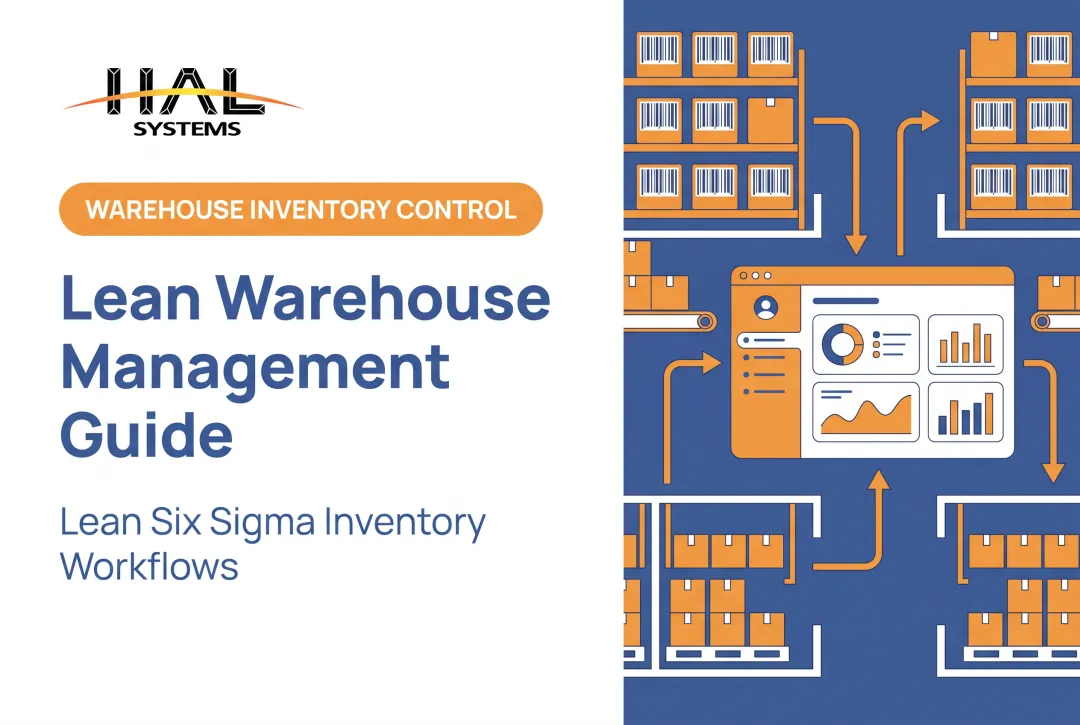

It's a customer-value-focused approach that cuts waste, improves the flow of materials and information, and replenishes stock based on real demand signals instead of guesswork. Done well, it keeps shelves and stockrooms stocked with the right items, not just fewer items.
This article walks through the five Lean principles, the seven wastes, the 5S framework, a practical implementation roadmap, the technology and metrics that make Lean decisions safe, and the guardrails that keep "lean" from becoming "too lean."
Key Takeaways
- Lean inventory management combines waste reduction, demand responsiveness, and continuous improvement, beyond just-in-time delivery alone
- Five principles (value, value stream, flow, pull, and perfection) tie inventory decisions to actual customer needs
- Accurate data, scanning workflows, and cycle counting make pull-based replenishment safe to execute
- Risk-based safety stock protects against demand spikes, long lead times, and supplier disruptions
Lean Inventory Management Principles
For distributors, manufacturers, 3PLs, and service organizations, Lean inventory management means stocking the right items, in the right quantities, at the right locations, at the right time, while cutting activities that don't create customer value. That goes beyond just-in-time (JIT) inventory alone.
JIT is a tactic, timing receipt or production close to the moment of need. Lean is the broader system around it, covering workflow design, quality, data accuracy, employee involvement, and ongoing improvement. The Lean Enterprise Institute's framework organizes this system around five connected principles.
Value
Inventory decisions should start with what the customer actually needs: product availability, quality, delivery timing, configuration, and reliable service. Skip this step and waste creeps in fast.
Example: A distributor stocks extra units of a slow-moving SKU because a sales rep "thinks" demand will pick up. Six months later, that inventory sits unsold, tying up capital and warehouse space until it's written off as obsolete. Validating the need first would have avoided the handling and carrying cost entirely.
Flow
Materials, information, orders, and work-in-process should move through receiving, storage, production, picking, shipping, or field deployment with as few interruptions as possible.
Common flow-killers include:
- Poor facility layouts that force extra travel between steps
- Duplicate data entry across disconnected systems
- Unclear handoffs between departments or shifts
- Bottlenecks at a single workstation or approval step
Each of these creates waiting, unnecessary motion, or rework, exactly the kind of waste Lean targets.
Pull
Pull-based replenishment triggers purchasing, movement, or production from actual consumption or a defined demand signal, not an unvalidated forecast. Instead of pushing inventory into the system based on predictions, you let real usage pull it through.
That said, forecasts still matter for:
- Long-lead-time materials that can't wait for a signal
- Seasonal demand planning
- Supplier capacity and production scheduling
- Overall warehouse or facility capacity planning
Pull and forecasting aren't opposites. Lean organizations use both, applying forecasts where lead times demand it and pull signals everywhere else.
Responsiveness and the Value Stream
Lean organizations map the end-to-end value stream, every step from order to delivery, to find non-value-adding activities and stay flexible when demand or supply shifts.
- Warehouse: Real-time visibility into pick-and-pack status lets replenishment orders trigger before a shortage hits, not after.
- Manufacturer: Mapping raw-material flow from receiving to WIP exposes where components sit idle between stations.
- Field service: Faster visibility into parts used on a job site supports more precise truck restocking instead of blanket over-stocking.
Perfection and Continuous Improvement
Lean never finishes. Perfection is a direction, pursued through Kaizen events, PDCA cycles, root-cause analysis, standard work, and regular review of inventory discrepancies.
Treat Lean as a management system, not a one-time warehouse cleanout. Teams that revisit cycle-count results and process metrics on a recurring schedule catch small problems before they become expensive ones.

Lean Waste and the 5S Framework
Taiichi Ohno's seven wastes give Lean teams a shared vocabulary for spotting non-value-adding activity in inventory operations:
| Waste | Inventory Example |
|---|---|
| Overproduction | Building WIP before the next process actually needs it |
| Waiting | Operators idle because a part hasn't arrived from receiving |
| Transport | Moving goods from the dock to a holding area, then again to storage |
| Overprocessing | Re-entering the same transaction data into two disconnected systems |
| Excess inventory | Stock sitting above what a controlled pull system requires |
| Motion | Staff searching for misplaced stock or missing tools |
| Defects | Reworking or scrapping items damaged in handling or storage |
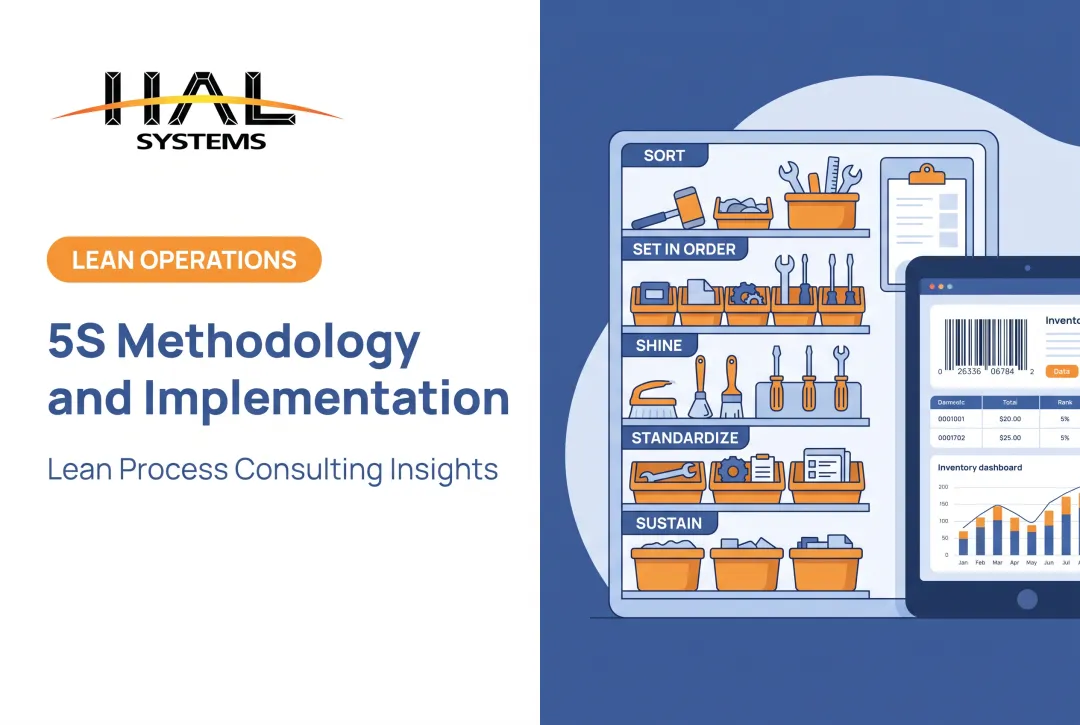
The 5S framework addresses many of these wastes directly:
- Sort – remove items that don't belong in the work area
- Set in order – label locations so every item has an assigned, findable home
- Shine – keep work areas clean enough to spot leaks, damage, or hazards immediately
- Standardize – document the procedures that keep sort, set in order, and shine consistent
- Sustain – audit regularly so the system doesn't quietly revert to clutter
5S isn't about making a facility look tidy. Labeled locations support faster, more accurate picking. Standard procedures reduce training time for new hires.
Recurring audits catch drift before it turns into inventory discrepancies. Each S should connect to something you can measure, like cycle-count accuracy or pick time per order.
How to Implement Lean Inventory Management
Rolling out Lean inventory management works best as a sequence, not a single project:
- Run a current-state assessment. Document inventory categories, locations, transaction steps, supplier lead times, demand variability, stockouts, and discrepancies.
- Map the flow. Trace the path from purchase or production through receiving, storage, WIP, picking, shipping, returns, and disposal. Flag which steps add customer value and which just add delay.
- Segment inventory. Group items by usage, value, criticality, lead time, variability, and shelf life. A single reorder rule applied to every SKU almost always under-protects critical items or over-stocks low-value ones.
- Set replenishment rules. Combine demand signals, reorder points, min/max levels, Kanban cards, and risk-based safety stock, matched to each segment.
- Strengthen collaboration. Review lead-time reliability, order quantities, and quality performance with procurement, sales, operations, and warehouse teams together.
- Standardize workflows. Document receiving, put-away, picking, issuing, returns, adjustments, and cycle counting, with clear ownership and training for each.
- Pilot before you scale. Test the new process in one warehouse zone, product family, or production cell. Compare baseline results against pilot results, then refine using frontline feedback.

This is also where the right software starts to matter. Spreadsheets and disconnected systems make steps 1 through 4 painfully slow.
For businesses that need configurable inventory, warehouse, WIP, or barcode-tracking workflows, HAL Traxx is worth evaluating. It uses modular software blocks you can configure for warehouse management, manufacturing inventory, or asset tracking.
It integrates with existing ERP, accounting, shipping, and eCommerce systems through APIs, ODBC, or transfer files, so the data behind your Lean decisions doesn't live in five different places.
Technology, Data, and Metrics for Lean Inventory
Lean decisions are only as good as the data behind them. Spreadsheets and disconnected systems obscure inventory location, quantity, status, and transaction history, exactly the information a pull system depends on.
Closing the Data Gap
Barcode scanning, mobile transactions, location control, and lot or serial tracking cut manual entry and the delays that come with it.
When purchasing, receiving, production, sales, shipping, and accounting all draw from the same records, teams stop re-keying data between systems and stop arguing over which number is correct.
HAL Traxx accepts barcode, RFID, lookup, and manual-entry input, and feeds that data into integrated reports or a SQL Reporting Service for custom analysis across the full database.
Metrics That Actually Matter
A focused Lean KPI set typically includes:
- Inventory accuracy (physical count versus system record)
- Stockout frequency
- Excess or obsolete inventory levels
- Carrying cost
- Inventory turnover
- Order cycle time
- Picking or issuing error rate
- Supplier lead-time adherence
For context, APQC's benchmarking data places median inventory accuracy around 95%, a useful reference point, though it's a cross-industry figure rather than a Lean-specific target.
Review these metrics together. A shrinking inventory number isn't a win if stockouts, expedited freight, or missed delivery commitments climb at the same time.
Dashboards, exception reports, and cycle-count results only create value when someone turns them into a root-cause review and an action item, not just a chart nobody opens.
If your Lean workflow requires configurable reporting alongside real-time inventory and asset visibility, HAL Traxx's dashboard and deployment options (on-premises or cloud) are worth comparing against what your current system provides.
Benefits, Risks, and Practical Limits
Done right, Lean inventory management delivers measurable operational gains. Results vary by operation, but the direction is consistent across industries:
- Lower carrying and handling costs
- Better use of warehouse space
- Fewer transaction errors
- Shorter process lead times
- More reliable fulfillment
Different customer segments apply these principles differently:
- Distributors tighten receiving and picking accuracy to cut shrinkage and mis-ships
- Manufacturers control raw materials and WIP to avoid idle cash on the production floor
- 3PLs separate client inventory by location and account to maintain visibility across multiple customers
- Field service teams track tools and parts across trucks and job sites to avoid replacement purchases for lost equipment
The Risk of Running Too Lean
Lean isn't the same as "minimal." Running too lean exposes a business to:
- Supplier delays with no buffer to absorb them
- Demand spikes that outpace replenishment lead time
- Inaccurate records that make pull signals unreliable
- Quality holds that remove stock from usable inventory without warning
- Transportation disruptions that stall inbound or outbound shipments
Mitigate these risks with:
- Risk-based safety stock for critical SKUs
- Qualified alternate suppliers
- Regular supplier performance reviews
- Differentiated controls for long-lead items
Highly customized or engineer-to-order operations often need a more flexible Lean design rather than rigid min/max rules. The goal is preserving customer value while removing waste, not hitting an arbitrary inventory number.

Frequently Asked Questions
What is a lean inventory management system?
It's the combination of Lean principles, replenishment rules, standardized workflows, accurate inventory data, and continuous improvement practices used together to reduce waste while still meeting demand reliably.
What are the 7 lean manufacturing principles?
Lean is typically described through five core principles: value, value stream, flow, pull, and perfection. The "seven wastes" (overproduction, waiting, transport, overprocessing, excess inventory, motion, and defects) are a separate framework often mistaken for "seven principles."
What are examples of lean production?
Examples include pull-based replenishment, Kanban signals, standardized work procedures, cellular flow layouts, cycle counting, barcode tracking, close supplier coordination, and recurring Kaizen events.
How is lean inventory management different from just-in-time inventory?
JIT focuses narrowly on receiving or producing materials close to when they're needed. Lean addresses that plus waste reduction, quality, workflow design, employee involvement, data accuracy, and continuous improvement.
How can a small business start lean inventory management?
Start with an inventory baseline, organized storage locations, accurate item records, and regular cycle counting. Set clear replenishment rules, pilot the approach in one area, then add barcode or inventory software as complexity grows.