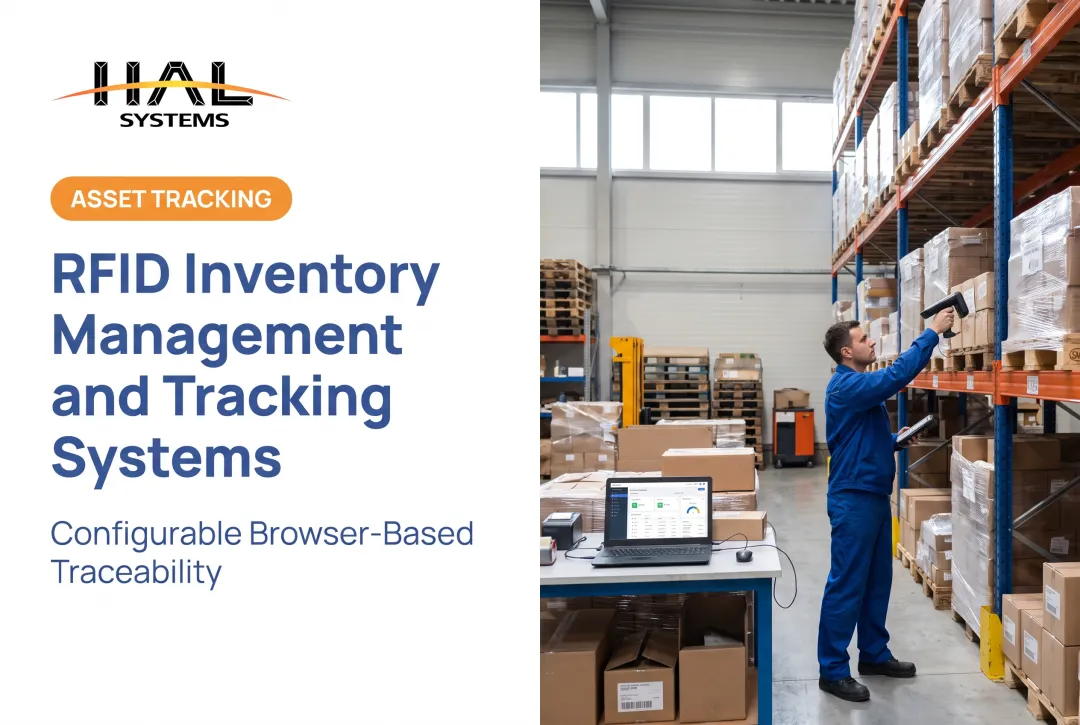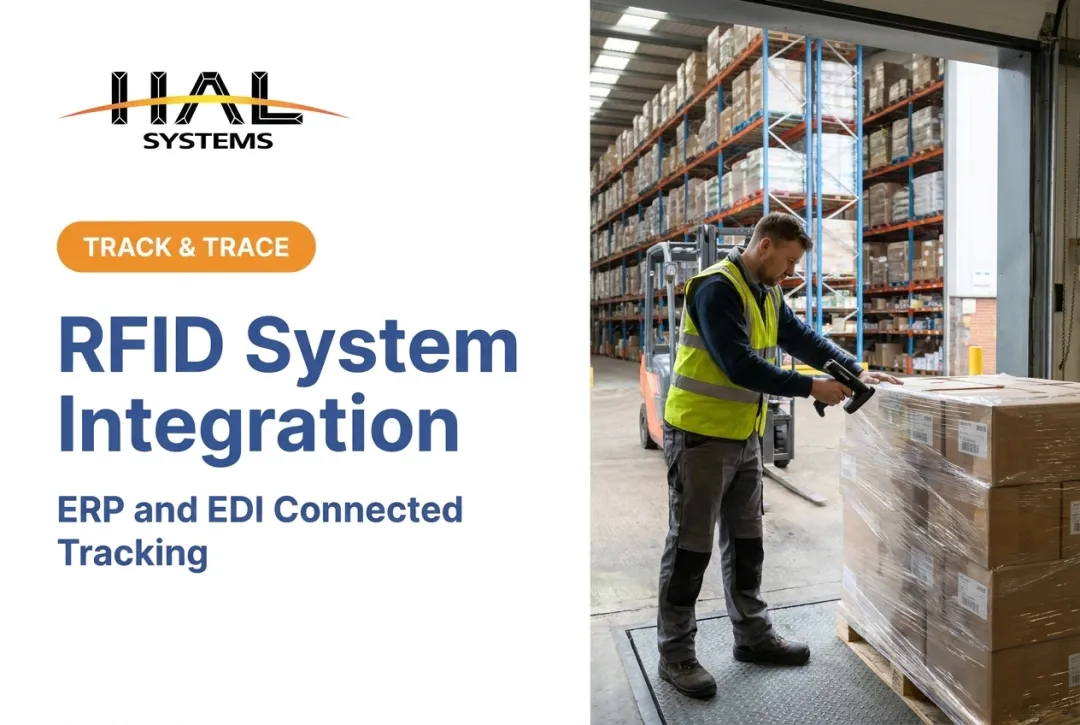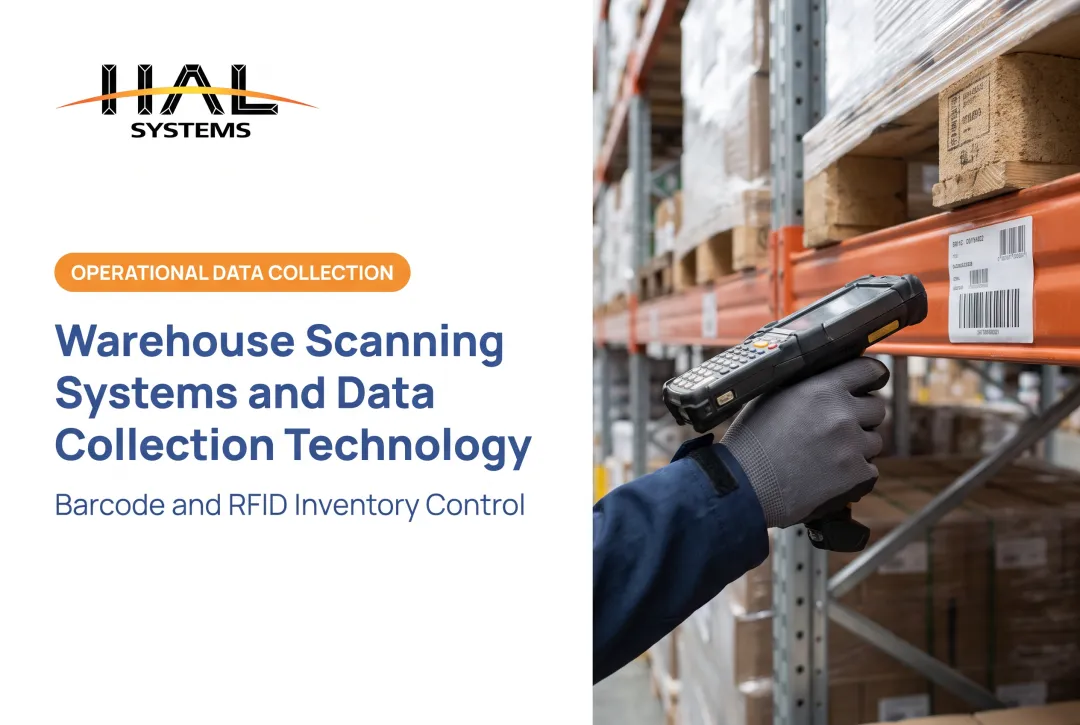

RFID can address these problems by capturing identification events automatically, without someone scanning each item. It is not a cure-all, though. Results depend on tags, reader placement, process design, and integration.
This guide defines RFID, explains how it captures supply chain events, compares it with barcodes, reviews use cases and benefits, and lays out a realistic implementation path.
Key Takeaways
- RFID uses radio waves, tags, readers, and software to capture inventory and asset events automatically.
- Visibility and less manual work show up only when tags, reader placement, and integration are done right.
- Barcodes stay in the mix; many operations run RFID alongside them, not as a full swap.
- Start with one measurable workflow and expand after a pilot proves reliable reads.
What Is RFID in Supply Chain Management?
RFID stands for Radio Frequency Identification. It identifies tagged products, cases, pallets, containers, tools, or equipment through radio-wave communication, with no need for a direct line of sight to a printed symbol.
One clarification: RFID records identification and movement events. A tag read at a dock door tells you the item passed that door. It is not GPS, and it doesn't track continuous location.
The main components of an RFID system
AIM describes a tag as a microchip plus an antenna, and a reader as a device that transmits electromagnetic waves. A passive tag harvests energy from that field to respond. A working enterprise system needs more than that:
- Tags carry a unique identifier attached to an item, case, pallet, or asset
- Readers and antennas, fixed or handheld, interrogate tags in range
- Middleware filters raw reads and removes noise
- Business systems such as a WMS, ERP, manufacturing, shipping, or asset platform turn a read into a record
Without the software and database layer, a read is just an ID with no meaning.
Tag types and RFID versus barcodes
Tag power design drives range and cost:
- Passive tags have no battery and draw power from the reader
- Active tags carry a battery and transmit on their own, with much longer range
- Semi-passive tags use a battery for onboard circuitry but still need the reader's signal to reply
The RAIN Alliance cites illustrative ranges of up to about 50 feet for passive UHF and up to about 330 feet for active 433 MHz tags. Treat those as guide examples, not guarantees.
| Factor | RFID | Barcode |
|---|---|---|
| Line of sight | Not required | Required |
| Simultaneous reads | Many tags nearly at once | One at a time |
| Data | Varies by tag memory | Varies by symbology |
| Durability | Depends on tag and application | Depends on label media |
| Complexity | Readers, tuning, testing | Simple, familiar |
RFID and GS1 barcodes can carry equivalent serialized identity, so RFID doesn't always hold more data. A hybrid approach is often more practical: RFID for high-volume counting or hard-to-scan items, barcodes for low-cost items and simple workflows.
How RFID Works Across a Supply Chain
Tagging and encoding items
Every tracked item, case, pallet, returnable container, or tool gets a unique identifier. GS1's EPC standard defines how that identifier is encoded and tied to keys such as a serialized GTIN. The tag is then linked to master data: SKU, lot, owner, location.
Plan for label durability, tag reuse on returnable assets, and clean item records. A tag attached to bad master data just produces bad data faster.
Capturing reads at checkpoints
Fixed readers sit at dock doors, conveyors, portals, storage areas, or production stations. Handheld readers handle counts and searches. Antenna placement defines the read zone, which determines where an event gets attributed. A read zone that spills into the next aisle will log items in the wrong place.
Turning reads into business events
A reader sends tag reads to middleware, which filters them and passes clean events to the WMS, ERP, or asset system. There the identifier resolves to a record. Typical events include:
- Receiving and put-away
- Movement between locations
- Picking and shipping
- Returns
- Tool or asset check-in and check-out
Using data for exceptions
Software compares expected reads with actual ones. Missing cases, misrouted shipments, incomplete picks, and unauthorized movements surface as exceptions. Not every raw read deserves an alert, though. A validated business event, such as "pallet left the dock without a matching order," should trigger the workflow; a stray read from a tag on a passing cart should not.
Testing read reliability in the real environment
Metal, foil, and water-based liquids significantly affect tag performance, according to Auburn's RFID Lab. Dense packaging, tag orientation, interference, and overlapping read zones add more variables.
Run a site survey and test real products, packaging, and equipment under real operating conditions before committing to a rollout.

RFID Applications Across Supply Chain Operations
Inventory and warehouse management
RFID supports core warehouse workflows:
- Receiving and put-away
- Location verification and cycle counting
- Picking and shipping
Faster item identification and better location-level visibility are the main gains. It won't deliver perfect accuracy, since misreads and process gaps still happen.
Manufacturing materials and work in process
Tags on raw materials, containers, or work orders let manufacturers capture movement between stockrooms, work cells, inspection points, and finished goods. An American Woodmark case study from ASCM used RFID to track cabinet doors through production and reported read rates of 99.6% or better. The data exposes bottlenecks and reduces paper travelers.
3PL and shared warehouses
Contract warehouses need client-separated records, verification of inbound and outbound goods, and tracking of reusable pallets, totes, and racks. When several customers share a facility, ownership rules, data boundaries, and event rules must be explicit before any tags go on.
Tools, equipment, and fixed assets
Field service firms, utilities, construction crews, public agencies, and schools need check-in/check-out histories and audit trails. Handheld and checkpoint reads support location verification, accountability, maintenance workflows, and annual inventories. GS1 identifiers such as GIAI (fixed assets) and GRAI (returnable assets) exist for exactly this.
Traceability and condition-sensitive goods
RFID can support lot, serial, recall, and chain-of-custody workflows where loss or misidentification is costly. Temperature monitoring is a different matter: a basic identifier tag can't record it. NIST notes that temperature readings require sensor-enabled tags or separate IoT devices.
Neither FDA framework mandates RFID. The Food Traceability Rule does not prescribe a particular technology, and DSCSA guidance describes barcode carriers.
Benefits of RFID for Supply Chain Management
Better visibility and data accuracy
Automated capture reduces manual transcription and creates a timely audit trail. The best evidence comes from controlled studies, and each has limits:
- University of Arkansas study of eight RFID test stores: understated perpetual-inventory inaccuracy fell about 13% vs. matched controls (preliminary, one product category).
- Dillard's apparel study at Auburn: cycle counts averaged 5.5 minutes with RFID vs. 2 hours 18.5 minutes with barcodes (one denim department, not a warehouse guarantee).
Treat these as signals, not promises.
Faster workflows
Bulk and hands-free reads cut repetitive scanning and searching during receiving, counts, movement checks, and shipping. Labor savings depend on process design, read reliability, exception handling, and how much manual work the system actually replaces.

Stronger traceability and decisions
Event history supports shipment verification, loss prevention, recall preparation, and production visibility. Measure before and after:
- Count time
- Order accuracy
- Search time
- Stock discrepancies
- Asset utilization
- Exception-resolution time
RFID Implementation: Challenges, Costs, and Best Practices
Build the business case around one workflow
Document the current process, pain points, transaction volumes, error sources, labor, service-level risks, and the value of the affected inventory.
Count total cost of ownership across:
- Tags, readers, antennas, and printers or encoders
- Middleware and system integration
- Site preparation, training, maintenance, and support
Tag cost varies with volume, memory, and packaging, so get quotes for your own situation.
Select tags, readers, and read locations
Match tag type and placement to material, packaging, read range, environment, and how often items move. Test in the conditions your goods actually face:
- Metal and liquids
- Dense goods
- Temperature and moisture
- Radio interference
Place readers at meaningful checkpoints, not everywhere. Extra readers create duplicate or misleading reads.
Start with a controlled pilot
Pick one facility, product family, asset class, or lane. Auburn's retail-focused guidance suggests pre-pilot baselines, matched control groups, and at least two months of operation, preferably four to six. Define success up front:

- Read reliability
- Count-time reduction
- Exception rates
- User adoption
- Data quality
- Integration performance
Keep a barcode or manual fallback while issues get resolved. Sandia National Laboratories' government-property pilot is a useful warning: building scores ranged from 61.2% to 93.9%, with obstruction and tag placement driving the gaps.
Integrate with existing systems
Align item masters, locations, serial and lot records, status codes, permissions, and event rules across the RFID software, WMS, ERP, and other platforms. Options include APIs, ODBC, transfer files, and middleware.
Security matters too. NIST SP 800-98 flags unauthorized reading, tag cloning, and denial of service. It recommends unique administrator passwords and firewall separation between RF and enterprise networks. Budget for training and data retention rules as well.
Use configurable software as you scale
Operational software is the layer that turns reads into workflow. HAL Systems' HAL Traxx is configurable for warehouse management, inventory management, asset tracking, or work-in-process control. It integrates with ERP, shipping, eCommerce, and accounting systems through APIs, ODBC, and transfer files, and accepts barcode, RFID, lookup, and manual input.
Treat it as a software layer to evaluate alongside your RFID hardware and middleware, and confirm hardware compatibility during scoping.
HAL Systems also offers Lean and Six Sigma process consulting. That's useful for fixing the workflow around the technology, since automating a broken process only speeds up the problem.
Plan for continuous improvement
After launch, review read exceptions, duplicate events, inventory discrepancies, user feedback, and KPI trends. Expand later to more locations, returnable assets, IoT sensor data, analytics, or AI-assisted anomaly detection. Do that only once the underlying data and processes are reliable.
Frequently Asked Questions
What is RFID in supply chain management?
RFID is a radio-wave method of identifying and tracking tagged items. Tags, readers, and software capture events such as receiving, movement, and shipping.
What does RFID stand for?
Radio Frequency Identification. It identifies tagged items, pallets, containers, or assets using radio signals.
How does RFID improve inventory accuracy?
It automates data capture, cutting manual-entry errors and giving item- or pallet-level visibility. Gains depend on reliable tag reads and solid system integration.
What is the difference between RFID and barcodes?
Barcodes need line-of-sight and are scanned one at a time. RFID reads many tags without line of sight, but tags can cost more and metal or liquids can interfere. Many organizations use both.
What are the main challenges of implementing RFID?
Common hurdles include upfront investment, tag selection, signal interference, integration, process changes, training, and data governance. A pilot surfaces most of them cheaply.