
Introduction
System integration cost in 2026 covers a wide spectrum. A pre-built connector might run a few hundred dollars a month with no setup fee.
A custom, multi-system project with bidirectional data flows can run into the tens of thousands of dollars before a single workflow goes live.
Many businesses struggle to budget for integration because vendors quote wildly different numbers for what sounds like the same project. Complexity, data quality, and custom build work drive cost more than the number of systems alone.
This article breaks down 2026 US pricing evidence, the factors that push costs up or down, and how to build a realistic estimate before you request quotes.
Key Takeaways
- System integration pricing ranges from low-cost connector plans to six-figure custom builds: there is no single average.
- Complexity, data quality, legacy systems, and bidirectional workflows drive most of the cost variation.
- A pre-built connector suits narrow, stable workflows; custom integration earns its price tag when logic or scale demands it.
- Total cost includes licenses, infrastructure, internal labor, training, and ongoing support, not just build hours.
How Much Does System Integration Cost?
Final pricing depends entirely on scope. Before comparing numbers, make sure any quote specifies:
- Assumptions and systems included
- Data flows covered and deliverables
- What's excluded
- Any recurring fees
Typical 2026 US Cost Ranges
Published US pricing evidence for 2026 is uneven: some categories have clear numbers, others don't. Here's what the evidence actually shows:
| Integration type | What the market shows | Typically included |
|---|---|---|
| Pre-built connector / EDI plan | Monthly plans from $450 to $850 depending on transaction volume and trading partners, often with no setup fee, per Zenbridge's EDI pricing | Standard connector, limited customization, overage charges for extra transactions or partners |
| Connector within existing software | Add-on connector access around $15 per user/month for premium connectors bundled into a subscription | Access to pre-built connectors already licensed in your existing platform |
| Standard API, file, or middleware project | Provider rates from $25–$49/hour to $100–$149/hour, with project minimums commonly starting around $10,000, according to Clutch's 2026 directory | Discovery, mapping, development, testing; scope varies heavily by provider |
| Custom or multi-system project | No reliable published universal range exists for 2026 | Custom logic, bidirectional sync, multiple data objects, legacy-system work |
| Enterprise iPaaS initiative | Vendors price by endpoints and flows rather than a flat project fee, making direct comparison difficult | Platform licensing, governance, security, and migration, usually quoted separately |

Don't compare a $450-a-month connector plan against a custom-integration quote unless both cover the same data volume, support period, and ownership costs. That's comparing a subscription to a project. They're not the same purchase.
The most useful quote isn't a single number. Ask vendors for three figures:
- A minimum viable integration
- A production-ready scope
- Optional future phases
That structure tells you what you're actually paying for at each stage.
Key Cost Factors and Total Cost Breakdown
Total integration cost combines technical complexity, business-process work, people, infrastructure, and ongoing operations. Build a cost checklist instead of focusing only on the initial build price.
System Type, Architecture, and Integration Method
Common approaches differ in speed, flexibility, and cost:
- Pre-built connectors deploy fastest but offer the least flexibility
- REST APIs give more control, depending on how well the target API is documented
- ODBC connections and transfer files suit older systems that lack modern APIs
- Middleware and iPaaS platforms add a management layer and their own licensing cost
Custom point-to-point connections solve a narrow problem well, but IBM's API integration guide notes they require substantial setup and ongoing upkeep, and they don't scale well once you're connecting hundreds of applications.
Number of Systems, Workflows, and Data Direction
Connecting two modern systems for a one-way data transfer is usually straightforward. Synchronizing several systems bidirectionally is a different project entirely. Cost climbs with:
- Additional data objects and child records that need mapping
- Higher transaction frequency or real-time requirements
- Branching logic for exceptions
- Error-handling and retry workflows
Data Quality, Mapping, and Migration
Poor data quality rarely shows up on a vendor's invoice line, but it drives real cost. Discovery, deduplication, field mapping, historical migration, and reconciliation all take time before development even starts. Legacy-system silos often carry redundant or inconsistent data that has to be cleaned, merged, and transformed before it's usable.
Legacy Systems, Infrastructure, and Deployment
Outdated databases, unsupported file formats, and limited APIs add development and testing work that newer systems don't require. On-premises hardware brings network and security considerations that cloud deployments handle differently. Neither approach is automatically cheaper; it depends on your existing infrastructure and compliance needs.
Implementation, Testing, Training, and Change Management
A full build includes discovery, solution design, development, user acceptance testing, security review, documentation, employee training, and post-launch support. Internal staff time during this process is a real cost, even if it never appears on a vendor invoice.

Recurring and Often-Missed Ownership Costs
Budget for these separately from the initial build:
- Licenses or SaaS fees, billed monthly or annually
- Middleware or API usage charges
- Cloud hosting, monitoring, and backups
- Security reviews and compliance updates
- Support and maintenance contracts
- Periodic data-quality cleanup
HAL Systems Relevance
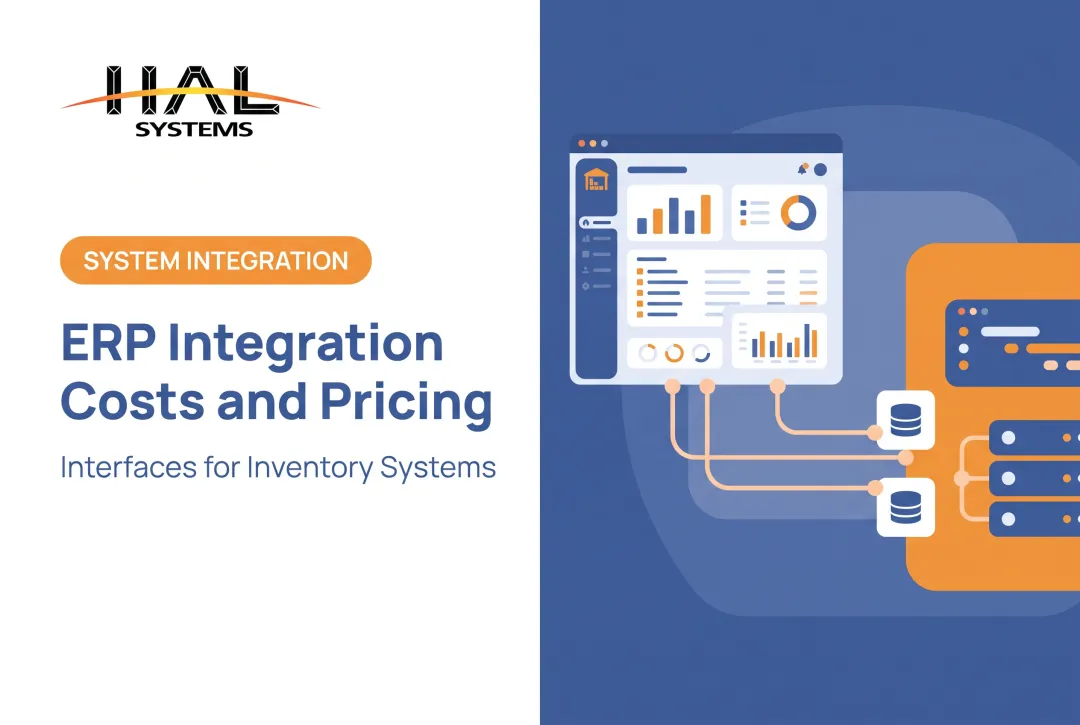
HAL Traxx connects with ERP, factory automation, shipping, e-commerce, and accounting systems using APIs, ODBC connections, or transfer files. Which method makes sense depends on the customer's existing environment, not a fixed template. A warehouse running an older ERP might need ODBC, while a business shipping through UPS or Amazon typically needs an API-based interface for order and tracking data.
Low-Cost vs High-Cost Integration — What's the Difference?
"Low cost" should mean appropriately scoped and maintainable, not simply the cheapest quote on the table.
Lower-Cost Integration
A lower-cost integration typically involves:
- A narrow, well-documented workflow
- A pre-built connector or simple file/API exchange between modern systems
- Limited data objects and one-way or scheduled transfers
- Minimal customization and fewer support requirements
Higher-Cost Integration
A higher-cost integration usually involves a production-critical or multi-system environment that needs:
- Bidirectional sync and real-time processing
- Complex data transformations
- Legacy-system access and high availability
- Custom error recovery
HAL Traxx's configurable software blocks are built to scale here. Features get added as needs grow, without forcing an upgrade to a new platform.
Long-Term Value and Risk
Paying more upfront for flexibility and monitoring can avoid manual workarounds, repeated rework, or an eventual replacement project. A $450-a-month connector that can't handle bidirectional sync might look cheap today and cost more in staff hours a year from now.
How to Estimate the Right Budget for System Integration
The right budget reflects the business outcome, acceptable risk, required data quality, and expected useful life of the integration, not just the lowest bid.
Define the Scope Before Requesting Quotes
Document these details up front:
- Systems involved, business goals, users, and processes
- Data objects and the source and destination of each data flow
- Synchronization frequency, required history, volume, and peak loads
Classify the Integration's Complexity
Identify whether the project is pre-built, standard, custom, or platform-level. Assess:
- API availability and documentation quality
- Whether data needs to flow one way or both ways
- How much transformation logic is required
- Legacy-system dependencies and compliance needs

Build a Complete Cost Model
Include every major cost category:
- Discovery, design, and development
- Licenses, middleware, and hosting
- Migration and data cleansing
- Testing, training, and deployment
- Support, monitoring, and contingency
Require vendors to separate one-time charges from recurring ones.
Estimate Value and Payback
Compare the full lifecycle cost against your current manual-entry hours, error correction, delayed reporting, and downtime exposure. Use your own operational data for this rather than borrowed ROI figures. HAL Systems, for example, works with customer personnel to build ROI calculations specific to their operation rather than relying on generic benchmarks.
Reduce Avoidable Cost Without Reducing Reliability
- Start with the highest-value workflow first
- Reuse standard connectors where they genuinely fit
- Clean up data quality before development begins
- Involve process owners early in scoping
- Test with representative, real-world data
- Document ownership of ongoing maintenance
HAL Systems combines configurable software, professional services, process optimization, and both cloud and on-premises deployment with ongoing support. Judge any provider on long-term operational support, not just the initial build quote.
Conclusion
System integration cost in 2026 depends on scope, architecture, data readiness, implementation effort, and ongoing ownership, not simply the number of connected applications. A two-system connector and a five-system bidirectional sync are different projects with different price tags, even if they sound similar on paper.
The best budget balances implementation speed, data accuracy, maintainability, and measurable business value. Before committing to any vendor, request a proposal that states its assumptions clearly: what's included, what's excluded, and what it costs to keep running after launch.
Frequently Asked Questions
How much does an integration cost?
Costs range from low-cost connector plans with no setup fee to custom projects starting around $10,000 and climbing well beyond that for multi-system builds. Compare scope, implementation, recurring fees, and support rather than relying on one average figure.
How much does it cost to implement an API integration?
Cost depends on API documentation quality, authentication complexity, data mapping, and whether the flow is one-way or bidirectional. Standard API projects commonly start near $10,000, with hourly rates from roughly $25 to $150 depending on the provider.
What are the four types of system integration?
Classifications vary, but common approaches include API-based integration, file-based or batch exchange, middleware or iPaaS platforms, and custom point-to-point or integration-platform builds. These aren't mutually exclusive. A project can combine several.
What is included in the cost of system integration?
A complete quote covers discovery, design, data mapping, development, testing, deployment, migration, training, and documentation, plus any separate software, hosting, or middleware fees charged on an ongoing basis.
What makes a system integration project more expensive?
Legacy systems, poor data quality, multiple platforms, bidirectional or real-time synchronization, custom business logic, security requirements, high data volume, and extensive testing all add cost and time to a project.
How can a business reduce system integration costs?
Define clear scope before requesting quotes, clean up data ahead of development, use pre-built connectors where they genuinely fit, and compare total ownership cost (not just the initial quote) across vendor proposals.