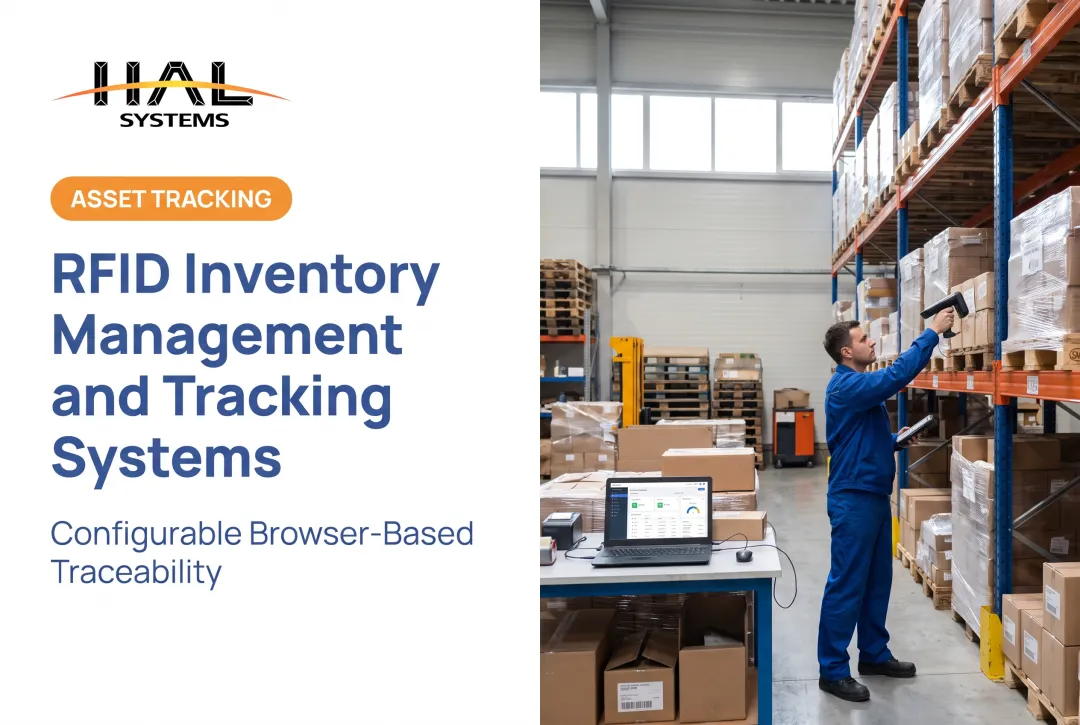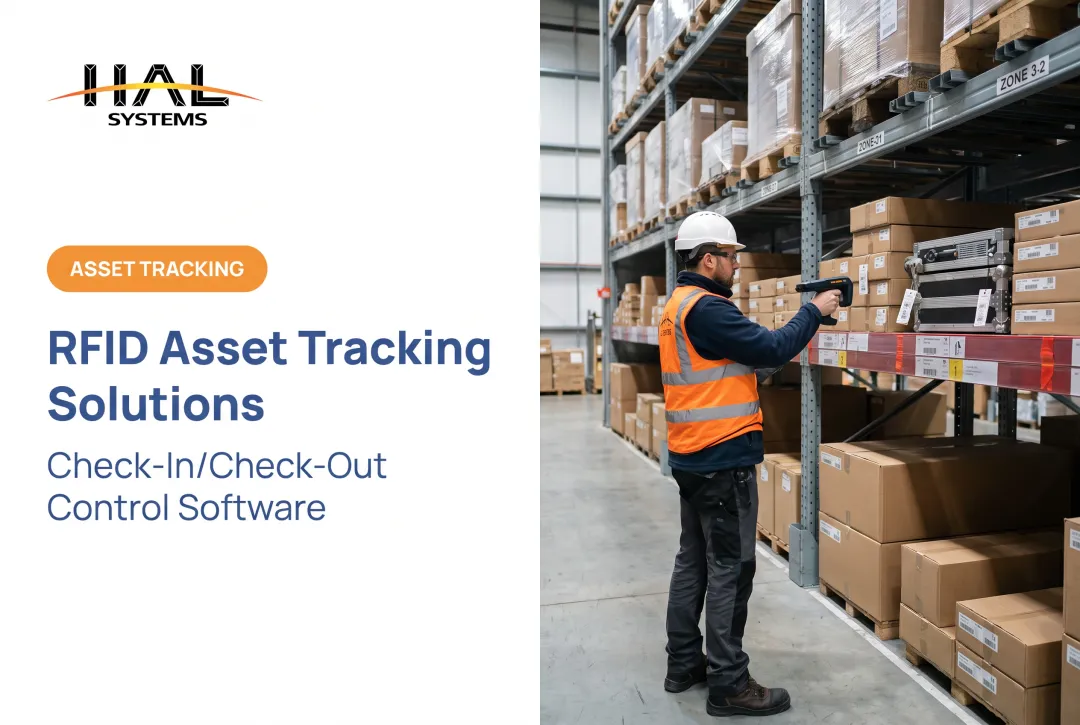

Introduction
Manual counts eat up hours your team doesn't have. Missed barcode scans create stock records that don't match what's actually on the shelf.
Receiving docks slow to a crawl while workers scan boxes one at a time. Nobody has real visibility into where inventory sits until someone walks the aisles.
RFID exists to fix exactly these problems. American Woodmark's case study found a 6% identification-error factor was corrupting inventory balances before the company adopted tag-based tracking.
This article covers how RFID warehouse inventory systems work, where they genuinely help, what limitations deserve scrutiny, and how to plan a pilot. The short version: RFID earns its cost when fast, non-line-of-sight scanning solves a specific workflow bottleneck and connects cleanly to your existing systems.
Key Takeaways
- RFID warehouse systems combine tagged inventory, readers, antennas, software, and defined workflows to track item movement
- Multiple tags can be read without line-of-sight, but results depend on tag choice, reader placement, and facility conditions
- Compare RFID against barcodes using inventory value, transaction volume, labor cost, and integration needs
- Start with a measurable pilot in one zone or process before attempting a full rollout
- Software that converts raw tag reads into trustworthy inventory events matters as much as the hardware
How an RFID Warehouse Inventory Management System Works
An RFID system has five working parts that turn a physical object's presence into a digital transaction:
- Tags attached to products, cases, pallets, or assets
- Antennas that send and receive radio signals
- Readers that capture the tag data
- Middleware that filters and validates events
- Warehouse or inventory software that updates records
Passive, Active, and Semi-Passive Tags
Tag choice drives everything else in the system. Passive tags draw power from the reader itself and typically read at a range of several meters. Active tags carry their own battery and transmitter, pushing read range to 100 meters or more, according to GS1's RFID guidance.
Semi-passive tags sit in between, using a battery to power onboard circuitry or sensors while still relying on the reader to transmit data.
| Tag type | Power source | Typical use case | Relative cost |
|---|---|---|---|
| Passive | Reader-supplied | Cartons, pallets, retail items | Lowest |
| Semi-passive | Battery + backscatter | Sensor-equipped assets | Moderate |
| Active | Battery + transmitter | Large assets, yard tracking | Highest |
Verify current specs with your tag vendor before committing. Range and durability figures vary by manufacturer, material, and application.
Reader Types and Where They Belong
- Fixed readers mounted at dock doors or storage zones for continuous capture
- Handheld readers for exception handling, spot checks, and mobile receiving
- Forklift-mounted readers that capture pallet movement during put-away
- Portal readers positioned at doorways or conveyor lines for bulk reads as goods pass through
Why Line-of-Sight Isn't the Whole Story
RFID doesn't need a direct line of sight the way a barcode scanner does, but tags still have to sit within an effective read zone. Metal surfaces cause signal reflection, liquids absorb radio waves, and densely packed tags can block each other out.
RFID doesn't need a direct line of sight the way a barcode scanner does, but tags still have to sit within an effective read zone. Metal surfaces cause signal reflection, liquids absorb radio waves, and densely packed tags can block each other out.
A typical warehouse flow looks like this:
- Tag goods at receiving and confirm the inbound shipment
- Verify storage location and record movement
- Support picking and packing
- Validate outbound shipments
- Close the loop with updated inventory and audit records
Benefits and Warehouse Use Cases
The clearest benefit is speed on repetitive counting tasks. A 2023 industrial experiment found barcode identification of 14 assets averaged 45.2 seconds. RFID identification of similar assets dropped to between 1.06 and 2.10 seconds in its best configurations, as reported in an Applied Sciences study.
That same test also included one tag mounted on metal that simply couldn't be read, a reminder that speed gains come with real limitations attached.

Receiving, Shipping, and Exception Handling
Bulk reads at a dock door let you match physical pallets against advance shipment data in seconds instead of minutes. This helps teams:
- Confirm case or pallet counts against purchase orders automatically
- Flag mismatches before goods leave the dock, not after a customer complaint
- Build a defensible movement history for audits and chargebacks
- Cut the manual re-scanning that slows down high-volume receiving
HAL Systems' HAL Traxx platform reflects this kind of workflow directly. Its Inventory Control – Warehousing application automates receipts, shipping documents, and delivery confirmation, whether the underlying input comes from a barcode scan, an RFID read, or manual entry.
Cycle Counting and Traceability
American Woodmark's rollout, documented in the case cited above, reached test-door read rates of 99.6% or better after tagging roughly 10,000 components and expanding across seven facilities and four external suppliers. That's a read-reliability figure, not a full inventory-accuracy benchmark, but it shows what's achievable once a process is tuned.
For distributors, 3PLs, and institutional asset teams, RFID-driven cycle counts mean less aisle-walking and less disruption to active picking. HAL Traxx's Track & Traceability functionality maintains a complete audit trail from source materials through final delivery, which matters for lot recalls and client-separated stock in contract warehousing.
RFID vs. Barcodes: Advantages, Limitations, and Costs
Neither technology wins every comparison. The right choice depends on your transaction volume, inventory value, and how much manual labor you're trying to remove.
| Factor | RFID | Barcode |
|---|---|---|
| Scan method | Bulk, no line-of-sight needed | One item at a time, direct sight required |
| Tag/label cost | Higher per unit | Lower per unit |
| Read reliability | Affected by metal, liquid, density | Consistent if label is visible |
| Data capacity | Higher, supports unique serialization | Limited to encoded symbology |
| Best fit | High-volume, high-value, frequent counts | Lower-volume or budget-constrained operations |
When RFID Justifies the Investment
RFID tends to pay off when an operation has high transaction volume, expensive inventory, frequent cycle counts, or costly error rates. If you're counting the same pallets weekly and paying overtime to do it, the math shifts quickly.
Barcodes often remain the more practical choice for lower-volume operations or facilities without the budget for infrastructure and integration work.
Building a Real Total Cost of Ownership
Skip the generic ROI claims you'll find online. Build your own estimate using:
- Hardware: tags, readers, antennas, applicators
- Software: licensing, configuration, middleware
- Integration: connecting readers to your WMS or ERP
- Training: process redesign and staff onboarding
- Maintenance: ongoing support and tag replenishment
HAL Systems offers software through an upfront license with annual support, or as an annual SaaS fee, so you can budget the software side of that total cost either way. Calculate payback using your own labor, error, and inventory data rather than someone else's case study.
How to Implement RFID Successfully
A rushed rollout is the fastest way to waste money on tags that don't read reliably. Work through these steps in order.
- Assess your current process. Document receiving, storage, picking, shipping, and counting workflows. Quantify what errors and delays actually cost today.
- Define the tracking level. Decide whether you need item, case, pallet, or asset-level tracking, and which events should trigger a system update.
- Test tags and readers on your actual products. Account for packaging, metal content, moisture, and placement before buying in bulk.
- Design the integration architecture. Map how RFID events flow into your WMS, ERP, shipping, and accounting systems, with clear rules for validating and deduplicating reads.
- Run a focused pilot. Pick one zone, product line, or process. Set baseline metrics for read reliability, count duration, and exception rates before you expand.
- Scale in stages. Add training, updated procedures, and maintenance ownership as you extend to new areas.

American Woodmark's documented rollout followed a similar arc. A cross-functional team tested inlays through actual production steps, funded a 10,000-component phase after proof-of-process success, then expanded to seven facilities.
Even then, the case reports ongoing issues with extraneous reads and metal-related signal bounce. Treat scaling as a continuing engineering process rather than a one-time event.
This is also where configurable software earns its keep. HAL Traxx's Business Rules, Authorizations, and Workflows let you define exactly which actions are allowed, who can perform them, and which steps are mandatory. The system matches your actual process rather than forcing you into someone else's standardized steps.
Choosing the Right System and Software Partner
Hardware gets the attention, but software is what turns a pile of tag reads into inventory you can trust. Before signing with any vendor, run through this checklist:
- Does the platform support barcode, RFID, and manual entry together, not just one input method?
- Can it integrate with your ERP, shipping, and accounting systems through APIs, ODBC, or file transfers?
- Does it offer configurable workflows instead of a fixed, one-size-fits-all process?
- What reporting and audit-history capabilities come standard?
- Is deployment available on-premises or in the cloud, depending on your IT preferences?
Questions Worth Asking Every Vendor
Ask every vendor directly about:
- Pilot support and environmental testing for your specific product mix
- Data ownership, system uptime, and offline operation during network outages
- How training and ongoing support work
- Whether you can add new workflows later without a platform migration
HAL Systems is one example worth considering for organizations that need configurable inventory or warehouse software rather than a rigid, single-purpose tool. HAL Traxx can be configured for warehouse management, inventory control, asset tracking, or work-in-process tracking, and it integrates through APIs, ODBC connections, or transfer files.
The company supports both on-premises and Amazon Web Services cloud deployment, along with reporting and process-optimization services grounded in Lean and Six Sigma methodology. As with any vendor, confirm RFID-specific hardware compatibility directly before finalizing a decision, since requirements vary by facility.

Frequently Asked Questions
What is RFID in a warehouse management system?
RFID stands for radio-frequency identification. Tags, readers, antennas, and warehouse software work together to capture an item's identity, movement, and status without requiring a direct line of sight.
How can RFID be used in inventory management?
RFID supports receiving, put-away, location tracking, cycle counting, picking, packing, shipping, returns, and asset or work-in-process tracking across a warehouse or manufacturing floor.
Is RFID better than barcodes for warehouse inventory?
Neither technology is universally better. The right choice depends on transaction volume, inventory value, accuracy requirements, facility conditions, and your integration needs.
How much does an RFID warehouse inventory management system cost?
Costs vary based on tags, readers, software, facility size, integration work, installation, and training. Build a total-cost and ROI estimate using your own baseline labor and error data rather than generic figures.
What are the main challenges of implementing RFID in a warehouse?
Common challenges include tag selection, metal and liquid interference, read-zone design, system integration, data quality, process changes, staff training, and ongoing maintenance.
How should a warehouse start an RFID implementation?
Start with a process assessment and a specific use case, test tags and readers on your actual products, run a limited pilot with clear baseline metrics, then expand in controlled stages once results hold up.