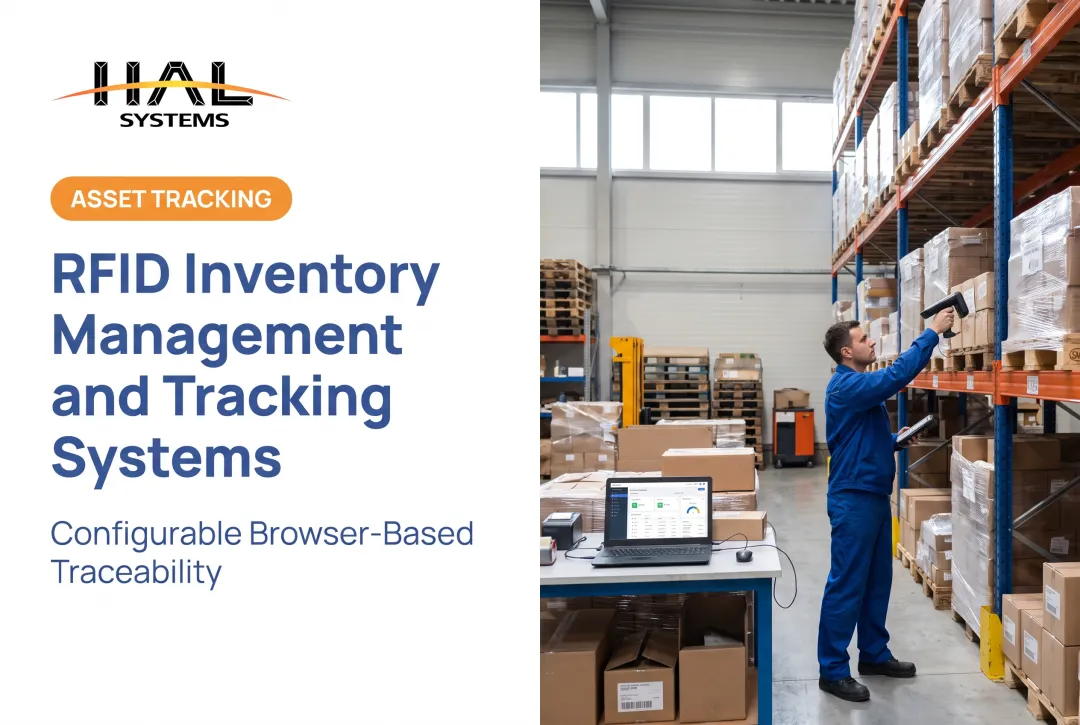

RFID asset tracking addresses these problems with tags, readers, tracking software, and the business workflows that connect them. Depending on how the system is designed, it can support identification, movement records, or location visibility. Those are different things, and confusing them is where many projects go wrong.
This guide covers how RFID works, where it pays off, how it compares with barcodes and other technologies, and what to evaluate before you buy.
Key Takeaways
- RFID reads many tagged assets without line of sight, but location detail depends on tags, reader placement, and software.
- Passive RFID suits counts, receiving, and checkpoints; active RFID or RTLS suits continuous monitoring.
- Choose by asset value, material, environment, accuracy needs, and integrations, not by hype.
- Pilot first, clean your asset records, and integrate with existing systems.
What Is RFID Asset Tracking and How Does It Work?
RFID asset tracking uses radio signals to identify tagged equipment and record where and when it was read. A basic asset register is just a list. A barcode inventory needs someone to scan each label. A GPS fleet tracker follows vehicles, not the tools inside them. RFID sits between these: tags answer readers automatically, and software turns those reads into records.
Per the RAIN RFID Alliance, readers send radio signals to tags, and each tag, made of a chip and antenna, responds with its data. Software then collects that data for inventory and asset tracking.
Identity is not location
Knowing what an asset is differs from knowing where it is now. A tag read at a doorway proves the asset passed that door. It does not give continuous, room-level visibility. Location tracking is typically a real-time location system (RTLS) function, layered on top of identification.
Tag types, readers, and supporting infrastructure
Passive tags have no battery. They draw power from the reader's signal, which keeps them cheap and maintenance-free. They fit inventory counts, receiving, cycle counts, and checkpoints. Passive UHF reads reach up to about 15 m under RAIN's illustrative guidance.
Active tags carry a battery and transmit on their own. Cisco notes active RFID ranges sometimes reach 100 m, which suits more continuous monitoring when compatible readers and location software are in place.
Tag selection depends on:
- Read range and battery life
- Durability and attachment method
- Operating environment
- Metal or liquid in or around the asset
Metal and liquid matter most. Metal reflects radio waves and can make standard tags inoperable, so use purpose-built on-metal tags. Liquids absorb energy and detune tags.
The supporting cast includes fixed readers, portal readers at doors, handheld readers, antennas, middleware, databases, dashboards, alerts, and reports.
The RFID asset tracking workflow
- Create a unique asset record.
- Attach or embed the tag.
- Capture reads at defined points.
- Associate each read with a location or event.
- Update the central system.
- Give authorized users access.

Those events support receiving, transfers, check-in/check-out, audits, maintenance status, shipping verification, and exception alerts.
Example: A field service company tags a pressure tester and links it to an asset record with calibration dates. A handheld read at the depot checks it out to a crew. A truck-mounted reader confirms it left. When it returns, a dock read closes the loan. If it hasn't been seen in 14 days, an alert fires.
Benefits and Use Cases of RFID Asset Tracking
RFID cuts repetitive one-by-one scanning and data entry because readers capture many tags at once. Process design still decides data quality, though. A reader pointed at the wrong spot produces bad records faster.
Better visibility connects to concrete outcomes:
- Faster inventory counts
- Fewer misplaced assets
- Stronger custody records
- Better utilization decisions
- Fewer duplicate purchases
Evidence supports the audit-time gain. German engineering firm Ludwig Pfeiffer reported cutting annual inventory labor by 50% across roughly 6,000 pieces of equipment, according to RFID Journal. That is one company's 2014 result, not a guarantee.
RFID data also supports maintenance and lifecycle management by tying assets to service history, status, inspection schedules, and movement records. Useful reports include:
- Assets by location
- Assets not seen within an expected period
- Movement history
- Overdue returns
- Inventory discrepancies
- Underused equipment
Examples by industry and workflow
- Distributors and 3PLs: receiving, putaway validation, location checks, shipping verification, cycle counts, and client-separated stock.
- Manufacturers: raw-material control, work-in-process visibility, reusable containers, tooling, and movement between production stages.
- Field service and construction: check-in/check-out across crews, trucks, depots, and job sites, with accountability for transfers and returns.
- Public sector, education, healthcare: periodic inventories, audit trails, equipment custody, and maintenance records for high-value or compliance-sensitive assets.
Cummins reported 99.9% data fidelity tracking returnable containers across 30 facilities.

RFID Compared With Other Asset Tracking Technologies
| Technology | Line of sight | Range / precision | Power | Typical use |
|---|---|---|---|---|
| Barcode / QR | Required | Point-in-time scan | None on label | Low-cost audits, scan-based ID |
| Passive RFID | Not required | UHF up to ~15 m; read-zone events | No tag battery | Receiving, counts, checkpoints |
| Active RFID | Not required | Up to ~100 m | Battery | Mobile high-value assets |
| BLE | Not specified | Typically 1-3 m accuracy | Low-power, long battery life | Indoor location |
| GPS | Satellite signal; degraded indoors | Variable, obstruction-sensitive | Powered device | Outdoor, fleet |
| UWB / RTLS | Anchor-based | Centimeter-level in specific designs | Powered tag | Precise indoor location |
Figures are guide-level "up to" values, not guaranteed field performance.
Barcodes and QR codes remain a lower-complexity choice for scan-based identification. RFID earns its place when teams need faster multi-item reads or can't count on a clear visual scan.
A hybrid often makes the most sense:
- Barcodes for low-cost audits
- Passive RFID at receiving or exit points
- Active RFID or BLE for mobile high-value assets
- GPS for outdoor or fleet visibility
Choosing based on business requirements
Start with the question you need answered:
- "What asset is this?" Barcode or passive RFID.
- "Where was it last read?" Passive RFID at checkpoints.
- "Is it in the right place?" Fixed readers or handheld audits.
- "Where is it now?" Active RFID, BLE, or UWB.
Then match the choice to your operating constraints:
- Asset mobility and material type
- Read volume and accuracy needs
- Indoor versus outdoor use
- Environment and budget
How to Choose, Implement, and Budget for an RFID Solution
Begin with a requirements assessment. Document:
- Asset categories and inventory volume
- Current tracking failures and movement points
- Users, locations, and existing software
- Compliance needs and the outcomes you will measure
Then map assets and processes before buying hardware. Decide where tags go, where reads must happen, and which events should update the system or trigger alerts.
Selecting tags, readers, software, and deployment model
Test on real assets. RAIN's field guidance says to verify performance on-site rather than assume lab results transfer. Test around metal shelving, liquids, machinery, loading docks, and dense storage.
Evaluate software for:
- Asset records and custody history
- Role-based access and audit trails
- Mobile workflows and alerts
- Maintenance fields
- Dashboards, reporting, APIs, and data export
Check integration with ERP, WMS, accounting, shipping, factory automation, or field service systems so nobody re-keys data.
HAL Systems offers HAL Traxx, a configurable platform for organizations that need broader inventory, warehouse, manufacturing, or business-management workflows around their tracking data. It accepts barcode, RFID, lookup, and manual entry, alone or combined, and interfaces with ERP, factory automation, shipping, eCommerce, and accounting systems through API, ODBC, or transfer files.
Deployment is on-premises or AWS-hosted. Validate RFID hardware compatibility and integration for each project before you commit.
Implementation and adoption
Run a controlled pilot on one asset class, location, or workflow. Set baseline measures and acceptance criteria first. Auburn's pilot guidance recommends matched pilot and control sites with periodic audits.

Cover these during rollout:
- Tag installation and reader placement
- Network and security review
- Asset-data cleanup
- User permissions and training
- Exception handling
- Replacing damaged or missing tags
Measure success with your own indicators:
- Inventory completion time and read accuracy
- Search time, unexplained loss, and duplicate purchases
- Utilization, overdue returns, and maintenance compliance
- User adoption
Set targets from your pilot baseline, not from vendor claims.
RFID tracking cost and ROI
There is no universal RFID price, so budget in two buckets.
One-time costs:
- Tags (on-metal tags cost more)
- Readers, antennas, and portals
- Installation and network work
- Software licensing or setup
- Integration, configuration, and training
Recurring costs:
- Hosting or annual support
- Battery replacement for active tags
- Tag replacement
- Ongoing process maintenance
Build the ROI model from before-and-after inputs: labor hours, replacement purchases, inventory disruption, shipping errors, unreturned equipment, and recovered asset value. GS1 UK lists reduced searching time, redistribution of underused assets, and fewer new purchases as potential benefits.
Ask vendors for a proof of concept or estimate based on your facility layout, asset materials, read points, volume, integrations, and location accuracy needs.
Buyer checklist:
- Scales as asset counts grow
- You own your data
- Documented integration methods
- Security controls
- Clear support model
- Implementation expertise, direct or through resellers
- Confirmed hardware compatibility
- Room to add workflows later
Frequently Asked Questions
How much does RFID tracking cost?
Cost varies with tag type, reader infrastructure, software, integration, installation, asset volume, and required accuracy. Request a scope-based estimate instead of relying on a generic price.
Can you track location using RFID?
Passive RFID gives read-point or handheld visibility. Active RFID and RTLS can provide more continuous location data when readers and software are properly deployed.
What is RFID in asset tracking?
It uses tags and readers to identify assets by radio frequency. Reads feed a central asset record that captures movement and inventory events.
Can a phone detect RFID?
Not all types. Many phones read NFC, which is 13.56 MHz HF RFID. UHF systems need a dedicated handheld, fixed reader, or external sled.