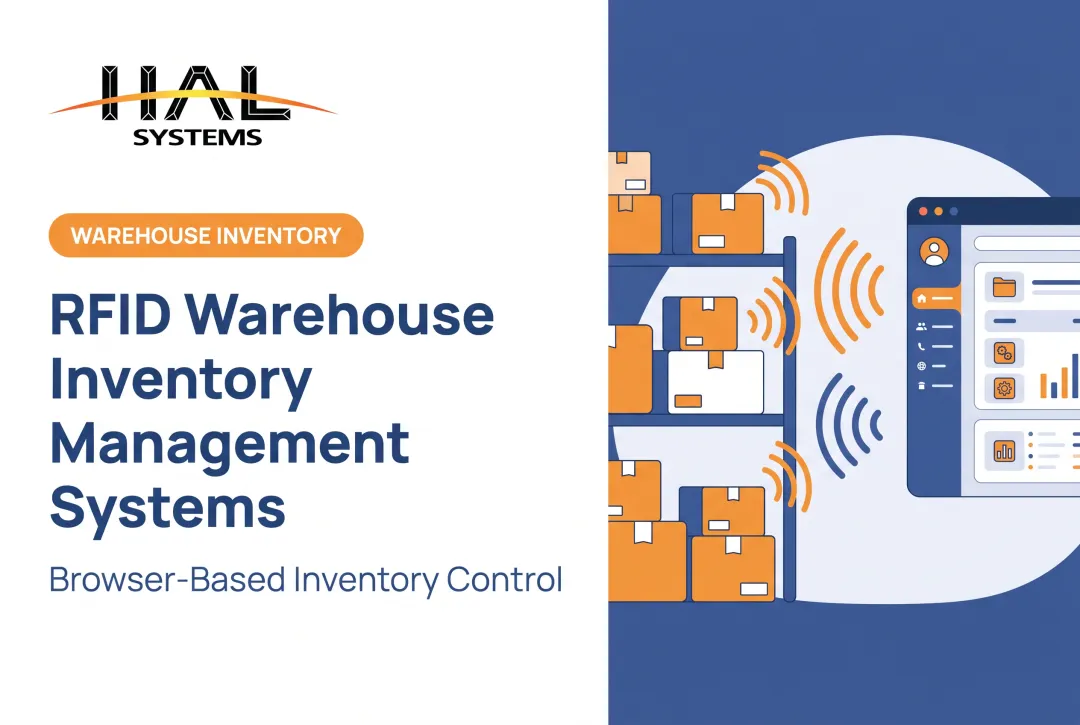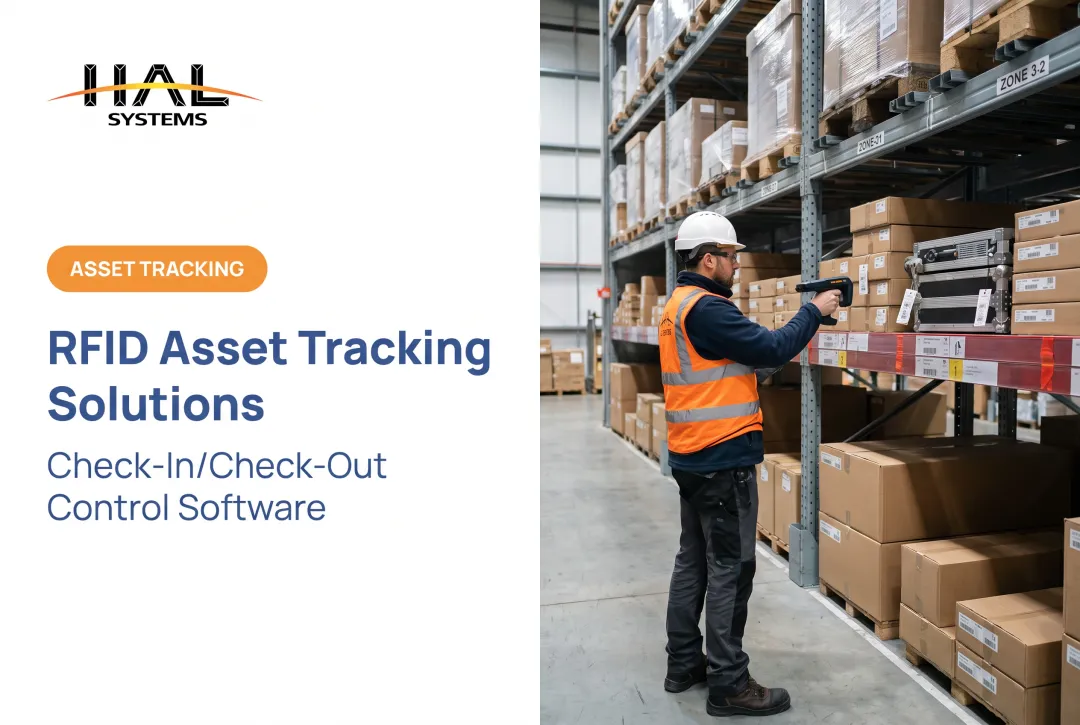

RFID inventory management uses radio-frequency identification tags, readers, antennas, and software to identify and track inventory, materials, assets, or work-in-process without scanning each item individually. Unlike barcodes, RFID tags don't need a direct line of sight to be read.
This guide covers how RFID actually works, the components involved, where it pays off, how it stacks up against barcodes, what it costs, and how to tell if your operation is ready for it.
Key Takeaways
- RFID identifies multiple tagged items without line of sight, but read performance depends on tag choice, placement, and materials
- A complete system includes hardware, software, integrations, and exception-handling processes, not just tags and scanners
- Investment pays off when inventory volume, counting labor, or traceability requirements are high enough to justify the cost
- A pilot with real inventory validates read performance and ROI before a company-wide rollout
How RFID Inventory Management and Tracking Systems Work
RFID stands for radio-frequency identification. A reader emits a radio signal; a tag picks it up and sends back its unique identifier over radio waves. No scanning angle required, no barcode to expose.
Most inventory tags are passive: they have no battery and draw power directly from the reader's signal, then respond using a method called backscatter. Active tags carry their own power source and transmitter, typically used for longer-range or higher-value tracking where passive range falls short. Neither type is automatically "better." The right choice depends on range needs, tag cost tolerance, and the environment.
The Event Flow, From Tag to Transaction
A read only matters once it becomes a business event. The typical flow looks like this:
- Tag the item — a container, pallet, component, tool, or asset gets a unique identifier
- Read the tag — using a handheld, fixed, portal, or vehicle-mounted reader
- Match the identifier — the system links the tag to an existing inventory record
- Interpret the event — as a count, receipt, movement, pick, transfer, or return
- Update records and trigger follow-up — alerts, reconciliation tasks, or downstream transactions in other systems

What Each Component Actually Does
- Tags carry item identity; specialized versions exist for metal, liquid, outdoor, or harsh environments
- Readers capture tag data through handheld, fixed, portal, or vehicle-mounted hardware
- Antennas shape the read zone, affecting range, orientation sensitivity, and coverage
- Inventory software turns raw reads into meaningful statuses, locations, and reports
- Integrations connect RFID events to ERP, WMS, accounting, or manufacturing systems
Two ideas often get blurred. RFID creates visibility at the read points you design and deploy. It is not continuous real-time location tracking unless you have built that specific infrastructure.
A warehouse with a fixed reader at the dock door knows when a pallet crosses that threshold, not where it sits on the floor five minutes later. HAL Systems' HAL Traxx platform builds this logic into configurable workflows, so a tagged pallet moving from receiving to storage to shipment generates the right transaction at each checkpoint and flags exceptions like a missing or unexpected item automatically.
Benefits and Use Cases of RFID Inventory Management
The appeal is straightforward: RFID can identify many tagged items in a read zone at once, instead of one scan at a time. Auburn University's RFID apparel study measured this directly at Dillard's. Counting 1,500 items took 5.5 minutes with handheld RFID versus 2 hours 18.5 minutes with handheld barcode scanning, a 96% labor reduction in that specific workflow. Treat that as a case benchmark, not a guaranteed result for every operation.
Core Operational Benefits
- More frequent, less disruptive cycle counts
- Better visibility into item location, status, and movement
- Fewer manual data-entry and transcription errors
- Faster location of misplaced or expected items
- Stronger verification during receiving, picking, and shipping
- Better audit trails for regulated or accountable inventory
RFID identifies discrepancies between expected and observed inventory and supports replenishment alerts and location updates. It does not eliminate the need for clean master data, trained staff, correct tagging, or sound physical processes. The technology surfaces problems; it doesn't fix bad workflows on its own.
Where RFID Shows Up by Environment
- Distributors and warehouses: receiving, put-away, cycle counts, picking, and 3PL client-separated stock
- Manufacturers: raw materials, components, work-in-process, reusable containers, and tools
- Field service and construction: truck stock, crew-assigned tools, and job-site transfers
- Public-sector and institutional teams: fixed-asset audits and equipment accountability
- Healthcare and food operations: lot and expiration-sensitive stock subject to compliance rules
A handheld periodic-count project needs far less infrastructure than a multi-site deployment with fixed readers and automated movement events. The business case scales with complexity.
HAL Traxx's Track & Traceability application, for example, maintains an audit trail from raw materials through customer delivery, including lot, batch, and recall tracing. That depth matters far more to a pharmaceutical distributor than to a small parts warehouse running occasional cycle counts.
RFID vs. Barcodes and Other Inventory Methods
Neither RFID nor barcodes guarantee accuracy without good labeling, clean data, and user adoption. But the mechanics differ in ways that shape which workflow fits.
| Dimension | Barcodes | RFID |
|---|---|---|
| Line of sight | Required: label must be visible | Not generally required |
| Bulk reading | One scan at a time | Multiple tags in one read zone |
| Item-level serialization | Possible, often batch-level | Designed for individual item tracing |
| Equipment cost | Lower | Higher, varies by tag type |
| Metal/liquid environments | Can be more reliable | Can require specialized tags |
GS1 US's research notes that barcode printing costs less and barcodes can actually outperform RFID in some metal-heavy or underwater conditions, while RFID's advantage is reading without line of sight and capturing tags nearly simultaneously.
When Barcodes Still Win
Barcodes remain the better fit when:
- Inventory movement is limited or low-volume
- Existing barcode infrastructure already works fine
- Automation requirements are minimal
- RFID's added cost and tagging complexity aren't justified by the error rate you're actually experiencing
When a Hybrid Approach Makes Sense
Many operations run RFID for high-volume counts and automated checkpoints while keeping barcodes as backup for items that don't read reliably, exceptions, or lower-value inventory. HAL Traxx is built for exactly this: it accepts barcode, RFID, lookup, and manual entry individually or in combination, so a mixed environment doesn't require separate systems.

Quick decision checklist before choosing:
- Inventory volume
- Labor hours spent counting
- Movement frequency
- Item material
- Traceability needs
- Existing systems
- Budget
- Real cost of inventory errors
How to Select and Implement an RFID Inventory System
Start with the operational problem, not the technology. Document current count times, discrepancy patterns, and the processes most likely to benefit before evaluating any hardware.
Define Your Data and Workflow Requirements
- Decide whether you need to track quantities, serialized items, lots, batches, or custody
- Map events: receipt, movement, issue, return, transfer, count, adjustment, shipment
- Identify required users, permissions, approvals, and exception-handling steps
Test Tags Against Real Conditions
Tag performance on metal, liquids, or dense packaging varies enormously. Test adhesive durability, temperature tolerance, and read reliability in your actual storage or production environment before committing to a tag type at scale. A tag that reads perfectly on a cardboard case may fail entirely on a steel drum.
Design Read Zones and Evaluate Software
- Choose handheld, fixed, portal, or vehicle-mounted readers based on the workflow
- Plan antenna placement and coverage to avoid duplicate or missed reads
- Confirm the software supports your required hardware, mobile workflows, and reporting
- Check integration options for ERP, WMS, accounting, and shipping systems
This is where configurable platforms earn their keep. HAL Systems' HAL Traxx is browser-based and accepts barcode, RFID, lookup, or manual input in any combination. Interfaces to ERP, factory automation, shipping, and eCommerce systems are built through API, ODBC, or transfer files.
It deploys on-premises or in the cloud, and its software building blocks can be added or rearranged without custom code, which helps if your RFID rollout starts small and grows. Confirm specific RFID hardware compatibility with HAL Systems before committing, since every deployment's read requirements differ.
Roll Out in Phases
- Set baseline measures: current count times, error rates, and search effort
- Run a limited pilot: representative inventory, real users, real conditions
- Test everything: read performance, transaction logic, integration accuracy, exception handling
- Train and refine: document tag standards before expanding
- Scale only after the pilot meets its defined goals

RFID System Costs, Challenges, and Limitations
Budget across five categories: tags and attachment costs, readers (handheld, fixed, portal, or vehicle-mounted), antennas and site infrastructure, software licensing and integration, and ongoing replacement or maintenance costs.
Tag Pricing Varies Widely
According to RFID Journal's pricing analysis, simple RFID labels run about $0.07 each at high volume, while protected passive UHF tags with housing run $1 to $2 each. Specialty tags with temperature sensors can reach $5, and active RFID transponders run $20 to $100 depending on features. None of these figures include readers, software, or integration — tag cost is not system cost.
Technical Limitations to Plan For
- Metal, liquids, and tag orientation affect read performance
- A tag that works on one product may fail on another
- Poorly designed read zones create missed, duplicate, or unintended reads
- Reads only become useful inventory data once mapped to business rules
Operational Realities
Existing ERP or WMS systems often need integration work. Teams still need procedures for damaged tags, unreadable items, and manual reconciliation — RFID doesn't eliminate exceptions, it just changes how often they occur. HAL Systems builds authorization controls directly into HAL Traxx, restricting who can perform certain transactions and requiring damage records where shrinkage control matters.
Go/no-go rule of thumb: RFID is more likely justified when counting labor, discrepancies, search time, or traceability requirements already create measurable costs. If the workflow is simple and those costs are low, barcode scanning may remain the more practical choice.
Building a Practical RFID Inventory Strategy
RFID isn't just a faster barcode. It's an integrated identification and workflow system, and its value depends on your inventory problem, your environment, and how well the data model is designed.
The practical path looks like this:
- Define the inventory problem first
- Test tags on real inventory
- Design read zones deliberately
- Evaluate software and integrations
- Run a measurable pilot
- Scale in phases

Distributors, manufacturers, field-service organizations, 3PLs, and institutional teams evaluating whether RFID fits their inventory workflow can look at HAL Systems' configurable HAL Traxx platform built to handle barcode, RFID, or mixed input, with implementation support and process-optimization consulting included. Contact HAL Systems to scope what a pilot would actually look like for your operation.
Frequently Asked Questions
What does RFID stand for and how is it used in inventory management?
RFID stands for radio-frequency identification. Tags attached to items communicate with readers over radio waves, and inventory software converts those reads into records of identity, location, status, or movement.
Can RFID be used for inventory tracking?
Yes, but coverage depends on tag selection, reader placement, and how read zones are designed. RFID only creates visibility where a workflow has actually been built to capture it.
How much does an RFID inventory system cost?
Total cost depends on tags, readers, antennas, software, integrations, site modifications, and training. Request a scope-based estimate rather than relying on a single generic price.
How much do RFID tags cost for inventory management?
Tag pricing varies by passive versus active design, order volume, material, and durability requirements. Simple labels can cost pennies; protected or active tags cost significantly more.
Which RFID tracking system is the best?
The best system fits your inventory environment, read workflow, integration needs, and budget. Test representative inventory under real conditions before committing to a platform.
What systems are used for inventory control?
Common approaches include manual records, spreadsheets, barcode systems, RFID platforms, warehouse management systems, and asset-tracking software. Many organizations combine several of these methods.