
Introduction
U.S. consumers now expect delivery within 3.5 days of placing an order, according to AlixPartners' 2024 survey. Add rising labor costs, shrinking talent pools, and inventory that spans more SKUs and more locations, and warehouse control stops being optional.
Spreadsheets, paper pick lists, and disconnected software can work fine at low volume. As order counts climb, though, those same tools create duplicate data entry, misplaced stock, and delays nobody can trace back to a root cause.
This article breaks down the practical advantages of a warehouse management system (WMS), the measurable outcomes businesses track, and what happens when warehouse control is left to chance.
Key Takeaways
- A WMS coordinates receiving, put-away, picking, packing, shipping, and inventory reporting in one system.
- Core advantages: better inventory accuracy, faster workflows, stronger fulfillment, lower avoidable costs, and real-time visibility.
- Results depend on clean data, consistent processes, user adoption, and regular KPI review.
- Configurable platforms support distributors, manufacturers, 3PLs, and asset-heavy operations without forcing a one-size-fits-all model.
What Is a Warehouse Management System (Brief Context)
A warehouse management system is software that directs, records, and analyzes how goods, materials, or assets move through a facility. It governs the entire operational sequence:
- Receiving and barcode or RFID scanning
- Location and slot management
- Cycle counting and replenishment
- Picking, packing, and shipping
- Returns processing and reporting
A WMS is not the same as a basic inventory spreadsheet. A spreadsheet tells you what you have. A WMS tells employees what to do next, enforces the process rules behind that action, and keeps a live record of quantity, location, and status as the transaction happens.
Deployment varies by organization. Some businesses run a standalone WMS; others use a module built into their ERP. Some keep servers on-site; others host everything in the cloud. None of these choices is universally correct. The right fit depends on IT resources, budget, and how the business already operates.
A WMS exists to produce outcomes: tighter control, better traceability, faster decisions, and consistent execution across every shift and every employee.
Key Advantages of a Warehouse Management System
The advantages below focus on outcomes a warehouse manager can actually track: time, cost, accuracy, service level, capacity, and risk. Vendor marketing tends to promise blanket productivity jumps. The evidence supports something more specific: directed, well-executed workflows produce measurable gains, but the size of the gain depends on the operation.
Improved Warehouse Efficiency and Workforce Productivity
Directed workflows remove guesswork. Instead of employees deciding where to walk or what to pick next, the system assigns tasks, confirms each step, and routes workers along optimized paths.
Pet product manufacturer and distributor Coastal Pet Products illustrates this well. Before installing a dedicated WMS, the company already had voice-directed picking and basic inventory software, but warehouse data ran a full day behind because updates processed in batches overnight.
After implementing a system that directed putaway to open locations, guided replenishment to pick points, and validated every order stage, MMH's case report describes higher daily throughput with a lower warehouse labor requirement, freeing staff to be reassigned elsewhere in the business.

KPIs this impacts:
- Receiving and put-away time
- Picking productivity (lines or orders per labor hour)
- Order cycle time
- Labor utilization and overtime
- Dock-to-stock time
This advantage matters most when order volume swings seasonally, travel distances across the facility are long, labor is hard to staff, or supervisors spend their day manually coordinating tasks instead of managing exceptions.
Greater Inventory Accuracy and Real-Time Visibility
Accuracy isn't automatic just because a WMS exists. A 2023 System Dynamics study published in Production models two failure types: "ghost inventory," where the system shows stock that physically isn't there, and "hidden inventory," where physical stock exists but isn't recorded.
Both create problems: ghost inventory sends pickers to empty bins, and hidden inventory triggers unnecessary replenishment. Cycle counting, the study finds, reduces both.
This is why a WMS pairs barcode scanning, location tracking, and disciplined cycle counts rather than relying on scanning alone. Done well, managers gain live visibility into:
- Available, allocated, and damaged stock
- Quarantined and in-transit inventory
- Work-in-process across multiple facilities
KPIs this impacts:
- Inventory accuracy and cycle-count variance
- Stockout frequency and order fill rate
- Shrinkage and inventory turnover
- Time spent investigating discrepancies
The payoff is largest for multi-location distributors, 3PLs separating inventory by client, manufacturers tracking raw materials and WIP, and any organization facing audit or recall requirements.
HAL Systems builds this discipline directly into HAL Traxx by enforcing lot and date control and requiring a damage record before shrinkage is written off. Those small rules close the gap between what's recorded and what's actually on the shelf.
Lower Avoidable Costs, Better Fulfillment, and Scalable Operations
Better inventory control and coordinated workflows reduce the costs that creep in quietly: mispicks, rework, returns, emergency shipments, and wasted floor space. The Coastal Pet case again shows the pattern: directed putaway into open locations improved space utilization alongside the throughput gains already mentioned.
A separate account from Peerless Research Group's survey found that even among warehouses reporting WMS use, 44% still relied on paper-based picking in 2024, down from 56% a year earlier. That gap matters: software ownership and full digital execution aren't the same thing, and the cost savings only materialize once paper-based steps are actually replaced.
KPIs this impacts:
- Cost per order and picking error rate
- Returns and expedited shipping frequency
- Order accuracy and on-time shipment rate
- Space utilization and inventory carrying cost
These benefits compound during seasonal peaks, business expansion, new customer onboarding, multi-channel fulfillment, or when adding warehouse locations. Those are the moments when manual coordination breaks down fastest.
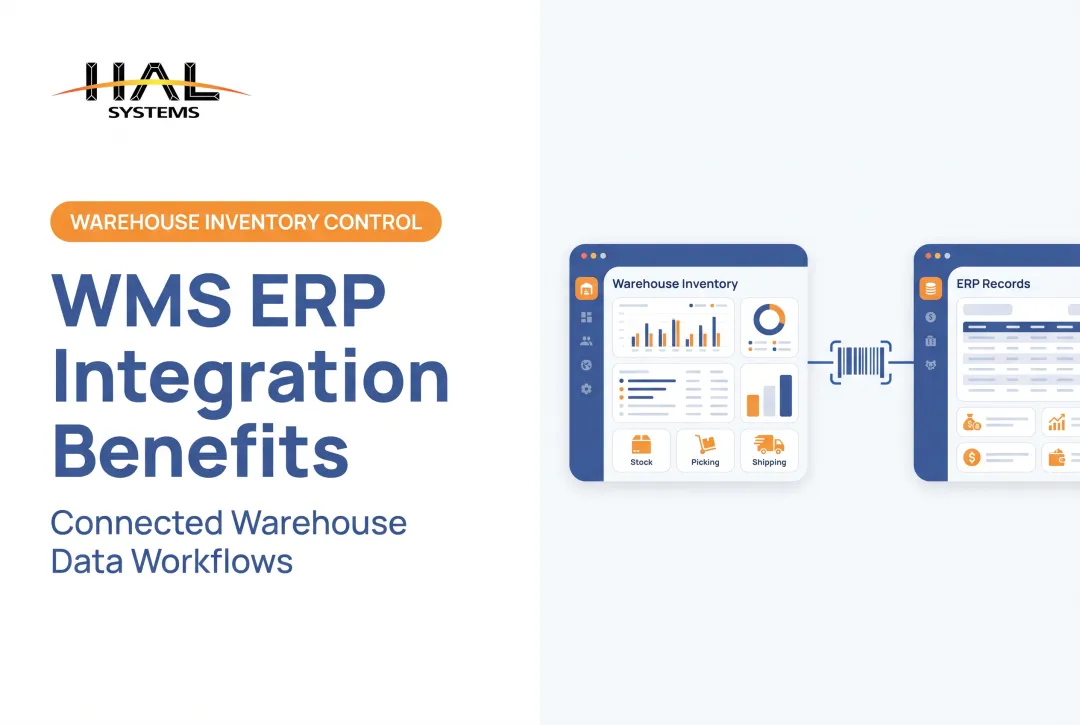
Integration determines how far these gains reach. A WMS that connects to ERP, accounting, shipping carriers, and eCommerce platforms eliminates duplicate entry and keeps every department working from the same numbers. HAL Traxx, for example, interfaces with these systems through APIs, ODBC, or transfer files, passing purchase orders for receiving, sales orders for picking, and shipping confirmations for invoicing automatically, without someone re-keying the same data twice.
What Happens When a Warehouse Management System Is Missing or Ignored
Disconnected spreadsheets and paper handoffs don't fail immediately. They fail quietly, through inconsistency that compounds over time.
Common consequences include:
- Mismatched records between receiving, production, picking, shipping, and accounting
- Higher error rates, rework, returns, and stock discrepancies
- Emergency purchases and expedited shipping to cover gaps nobody saw coming
- Reactive management, since supervisors lack timely data on bottlenecks or labor needs
- Difficulty training new employees or proving transaction history during an audit
Coastal Pet's pre-WMS experience is a useful, concrete example. Warehouse data lagged a full day behind actual activity because updates ran in overnight batches. That gap forced extra weekend shifts just to reconcile stock counts with real order information: labor spent fixing a visibility problem instead of fulfilling orders.

Implementing a WMS doesn't automatically fix any of this. Inaccurate item master data, weak scanning discipline, insufficient training, or integrations that don't match actual workflows simply move the same problems into a digital format. The software enforces whatever process you give it, good or bad.
How to Get the Most Value from a Warehouse Management System
A WMS performs best when a business starts with documented objectives, a current-state process map, clean item and location data, and a baseline set of KPIs to measure against.
Build Consistency Before You Automate
Define standard rules for receiving, labeling, put-away, replenishment, picking, counting, and shipping, then train every employee to follow the same workflow. Match barcode, lot, serial, and approval requirements to how the business actually operates, not to a feature list that sounds impressive but goes unused.
Plan Integration and Implementation Deliberately
Before launch, map out:
- Data migration: clean item, location, and customer records before go-live
- User roles and exception handling: define who approves overrides and how
- System integrations: connect ERP, accounting, shipping, and eCommerce platforms
- Deployment model: weigh on-premises installation against cloud hosting (HAL Systems, for instance, offers both on-premises and Amazon Web Services cloud deployment, so IT capacity and budget can drive the decision rather than a vendor's default)
HAL Systems' HAL Traxx platform is built around this flexibility. It functions as a warehouse management system, an asset-tracking tool, or a work-in-process manufacturing solution, and businesses can combine those functions or add new ones later without replacing the underlying platform.
Configurable business rules and role-based authorizations let a distributor, a 3PL managing separate client inventories, or a manufacturer tracking WIP each set up the system around their actual operation, not a generic template.
Review Performance on a Regular Schedule
Implementation isn't a finish line. Track inventory accuracy, order cycle time, picking productivity, and cost per order on a recurring basis, and use the reports to find repeat bottlenecks. Applying Lean or Six Sigma principles to those findings, rather than just collecting dashboards, is what turns a WMS into an ongoing improvement tool instead of a one-time project.

Conclusion
The real advantage of a warehouse management system goes beyond digitizing a stock count. You gain tighter control over workflows, clearer operational data, better accuracy, and execution that does not depend on which employee is working that shift.
Those benefits show up most clearly when the system connects to surrounding business software, when warehouse teams actually adopt the new process, and when results get measured against KPIs specific to that business, not generic industry benchmarks.
Treat a WMS as a foundation for continuous improvement, not a finished project. The right platform should match your workflow complexity, budget, and deployment preferences today, while leaving room to add functionality as the operation grows.
Frequently Asked Questions
What are some examples of warehouse management systems?
Examples include standalone WMS platforms, warehouse modules built into ERP suites, and cloud-based WMS software. Configurable platforms like HAL Traxx also combine warehouse, inventory, and asset-tracking functions in one system.
What is the role of a warehouse management system?
A WMS directs and records warehouse activity from receiving through shipping while giving managers real-time visibility into inventory and locations. It supports task execution and reporting, helping teams improve accuracy, efficiency, cost control, and service.
Does a WMS work for small or mid-size warehouses, not just large distribution centers?
Yes. Configurable systems scale down to one or two stocking locations and scale up as volume grows, which avoids paying for tier-one WMS features a smaller operation doesn't need yet.
How long does a typical WMS implementation take?
Timelines vary with data cleanliness, integration complexity, and process documentation. Businesses that map workflows and clean item data beforehand generally implement faster than those starting from scratch.
Can a WMS integrate with our existing ERP and shipping software?
Most modern systems connect to ERP, accounting, shipping carriers, and eCommerce platforms through APIs, ODBC, or transfer files, which keeps purchase orders, sales orders, and shipping confirmations synced without duplicate entry.