
Most teams feel the gap before they name it. Spreadsheets lag behind the warehouse floor. Counts drift. Stock gets misplaced, so you run out of one item while another piles up. Capterra's buyer research found that about 34% of small and midsize buyers still rely on manual methods. The same disconnect shows up when accounting, shipping, and ecommerce each hold a different version of the truth.
This article defines the technology, explains how it works, covers the main tool categories, and shows how to choose and roll out a system.
Key Takeaways
- Inventory management technology captures, organizes, analyzes, and acts on inventory data across the whole operation.
- A practical system combines software or a WMS with barcodes, mobile scanners, RFID, and integrations.
- Technology can't fix bad item data, weak processes, or untrained staff.
- Choose based on inventory type, workflows, locations, integrations, budget, and growth plans.
What Is Inventory Management Technology?
Inventory management technology is the combination of software, hardware, databases, integrations, and automation that helps a business track and control inventory throughout its lifecycle.
Inventory management is the business process. The technology is what supports it. A simple example: a paper receiving log becomes a barcode-enabled workflow, where the receiver scans each item against the purchase order and the record updates immediately.
What Does Inventory Management Technology Track?
A system can record far more than quantity:
- Item or SKU identity and unit of measure
- Location and movement history
- Lot, batch, serial number, and expiration date
- Ownership, which matters for third-party stock
- Status: available, allocated, damaged, in production, or in transit
The inventory itself varies by operation. It may be raw materials, components, work-in-process, finished goods, packaging, tools, equipment, or fixed assets.
How Is It Different From Related Systems?
These systems overlap, but each has a main job:
| System | Primary purpose |
|---|---|
| Inventory management software | Item records, quantities, locations, transactions |
| WMS | Warehouse execution: receiving, putaway, picking, packing |
| ERP | Enterprise-wide finance, purchasing, production, and sales |
| Order management system | Following customer orders from placement to return |
| Asset-tracking software | Locating and controlling physical assets |
Any of these can run standalone or connect to accounting, ecommerce, shipping, procurement, factory automation, or field-service tools. The point of connecting them is that inventory data flows between departments instead of being retyped.
How Does Inventory Management Technology Work?
The core data cycle has five steps:
- An item is identified at a transaction point.
- The movement is recorded.
- The central inventory record updates.
- The system applies business rules.
- Users receive an alert, task, report, or recommendation.
How Is Inventory Data Captured?
Barcode labels, handheld scanners, mobile computers, RFID tags, fixed readers, sensors, electronic forms, and integrations all capture events. These events happen during purchasing, receiving, putaway, picking, transfers, cycle counts, production, returns, and shipping.
Data capture stays useful only with discipline. Consistent item IDs, location codes, units of measure, and labeling standards keep data meaningful across warehouses, production areas, trucks, and job sites. Label quality matters too: GS1 US and VDC Research report that 70% of logistics organizations hit barcode readability problems weekly.
How Do Systems Support Daily Workflows?
Take receiving. The system compares an incoming shipment with the purchase order. The receiver scans or enters items, records discrepancies, assigns storage locations, and releases accepted stock for use.
The same logic guides putaway, picking, packing, transfers, cycle counts, replenishment, returns, work-in-process moves, and tool check-in/check-out. Every step leaves an activity history you can investigate later.
How Do Integrations and Reporting Add Value?
Integrations with ERP, accounting, e-commerce, shipping, procurement, or factory systems cut duplicate entry and keep orders, purchasing, production, and financial records in sync.
Dashboards and alerts then highlight issues such as:
- Low or aging stock
- Count discrepancies
- Delayed receiving
- Supplier issues
- Order status gaps
- Poor location utilization
How Does Technology Support Decisions?
Current and historical data inform reorder points, safety stock, demand planning, cycle-count priorities, allocation, and supplier reviews. Systems can recommend; people decide. A suggested reorder quantity doesn't know a key customer is about to double their order, or that a supplier just flagged a delay.

What Technologies Are Used in Inventory Management?
Inventory technology is usually a connected stack, not one device. The right mix depends on item characteristics, transaction volume, warehouse layout, compliance needs, and workflow complexity.
Inventory Management Software, WMS, and ERP Platforms
Inventory software maintains item records, quantities, locations, transactions, replenishment, order allocation, reporting, and user permissions.
A WMS typically handles detailed warehouse execution. An ERP ties inventory to finance, purchasing, production, sales, and planning. The two are often integrated, with the ERP as the business record and the WMS running the floor.
Barcode Scanners and Mobile Devices
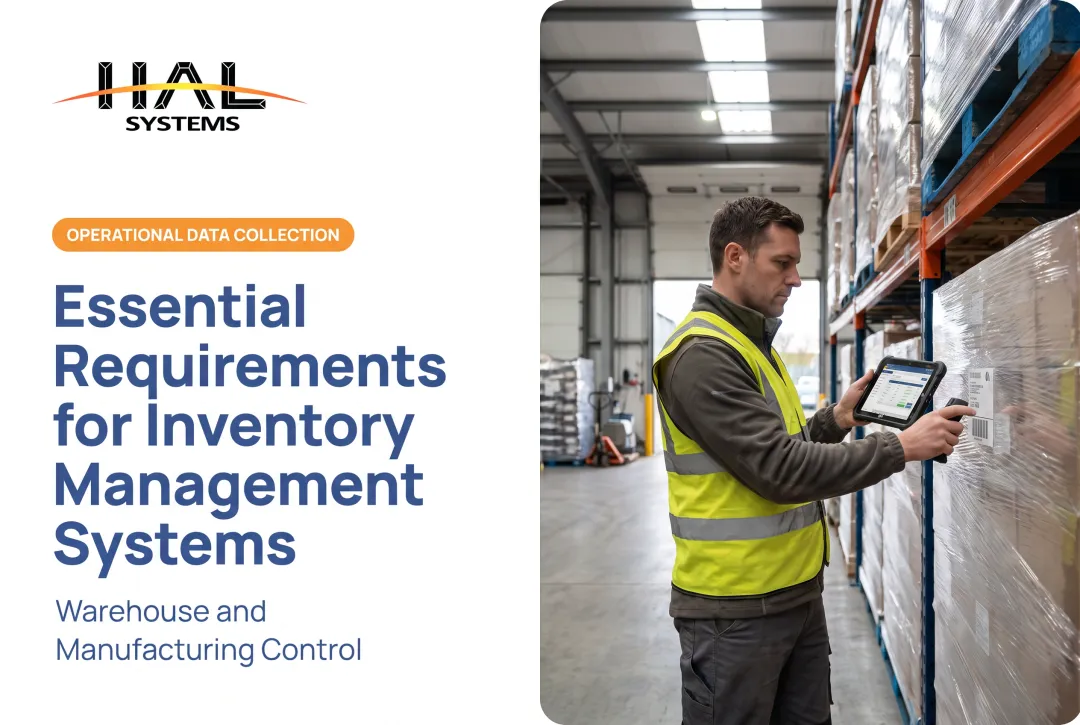
Barcodes are the most accessible way to identify items and locations. Handheld scanners, tablets, and mobile computers let employees update records where the work happens.
Common uses include:
- Receiving and picking
- Cycle counting and location transfers
- Issuing materials to production
- Tool check-out for field service
- Fixed-asset audits
Scanning doesn't guarantee accuracy. Poor labels and sloppy procedures produce fast, confident errors.
RFID and IoT Sensors
RFID reads tagged items without the line-of-sight most barcode scans need, which suits high-volume, high-value, or traceability-heavy workflows. Liquids and metal can degrade performance, so test in your own environment. Project Zipper's retail study found RFID shipment reconciliation produced order accuracy above 99.9%. That was a bounded retail study, not a promise for every operation.
IoT sensors can monitor location, movement, temperature, or humidity. Deploy them only against a specific need, such as cold-chain monitoring.
Automation and Warehouse Equipment
Options include pick-to-light and put-to-light systems, conveyors, automated guided vehicles, robotics, and fixed scanning stations. They cut repetitive work and raise throughput.
They also demand standardized processes, reliable master data, suitable facility design, maintenance, training, and integration with the inventory system. Automating a messy process just makes the mess faster.
AI, Predictive Analytics, and Cloud Technology
Analytics and machine learning can spot demand patterns, flag anomalies, recommend replenishment, and support scenario planning. Forecasts are only as good as the underlying data.
Cloud deployment offers centralized access, automatic updates, and multi-location collaboration. On-premises gives more control over infrastructure and data location. NIST's guidance doesn't name a universal winner; it points to cost, security, network availability, portability, and exit planning as the factors to weigh.

What Are the Benefits and Applications of Inventory Management Technology?
Well-run systems typically deliver:
- More timely inventory visibility
- Fewer manual entry errors
- Faster receiving and fulfillment
- Better use of labor
- Stronger traceability
- Smarter purchasing, with fewer stockouts and less overstock
At scale, the financial stakes are high. IHL Group estimates global retail inventory distortion at $1.7 trillion, about 6.2% of retail sales. That is an enterprise retail figure, not a small-business benchmark, but the pattern holds: both too little and too much stock cost money.
Where It Applies
- Distributors: warehouse locations and order picking
- Manufacturers: materials and WIP tracking
- Field service and construction: tools across crews and vehicles
- Public sector: barcode audit trails for fixed assets
- 3PLs: inventory separated by client
Where It Falls Short
Technology doesn't replace process discipline. Results stall when foundations are weak:
- Poor item masters
- Inconsistent labels
- Weak location controls
- Incomplete integrations
- Thin training
- Cybersecurity gaps
- Low user adoption
How Do You Choose and Implement the Right Technology?
Start With the Problem
Document inventory types, locations, transaction volumes, users, current systems, manual workarounds, accuracy issues, and reporting needs. Then name the outcomes you want to improve.
Evaluate Against Clear Criteria
- Barcode or RFID support
- Lot and serial tracking, plus WIP or asset functionality
- Multi-location controls and replenishment
- Reporting, APIs, and other integration methods
- Mobile usability and cloud or on-premises options
- Scalability, security, and total cost
- Training, implementation help, and ongoing support
When you score vendors against those criteria, look for a clear workflow fit. HAL Systems' HAL Traxx is one example: a configurable, browser-based platform that can serve as inventory management, warehouse management, asset tracking, or WIP manufacturing software.
It connects to ERP, accounting, ecommerce, shipping, and factory systems. It deploys in the cloud or on-premises, with inputs from barcode, RFID, lookup, or manual entry. Treat it as an illustration of fit, not a universal recommendation.

Roll Out in Phases
- Clean item, location, supplier, customer, and asset data.
- Define roles and operating procedures.
- Pilot one workflow or location.
- Train users by role.
- Validate integrations and reports.
- Measure agreed KPIs, such as inventory accuracy by item, quantity, and location.
- Expand only after fixing issues the pilot exposed.
Security belongs in the plan. NIST's small-business guidance recommends hardware and software inventories, multifactor authentication, least-privilege access, patching, and tested backups.
Frequently Asked Questions
What are the 5 stages of the inventory management process?
One common model: planning and purchasing, receiving and storage, tracking and control, fulfillment or use, and review and replenishment. Organizations divide the stages differently.
What are FIFO, LIFO, and JIT?
FIFO uses or sells older stock first; LIFO uses newer stock first. JIT times inventory arrival close to when it's needed. Accounting treatment can differ from physical movement.
What are some technologies used in inventory management?
Inventory software, WMS and ERP platforms, barcode scanners, mobile computers, RFID, IoT sensors, analytics, cloud systems, automation, and AI-supported forecasting.
How does inventory management technology improve accuracy?
Standard item IDs, point-of-activity scanning, real-time updates, cycle counts, validation rules, and audit trails reduce manual entry and make discrepancies easier to trace.
What is the difference between inventory management technology and a WMS?
Inventory management technology is the broad category of tools. A WMS is one system focused on warehouse execution: receiving, putaway, storage, picking, packing, and movement control.
How do I choose inventory management technology for a small or midsize business?
Start with your highest-impact workflow problems. Then compare usability, required hardware, integrations, deployment, scalability, support, security, and total cost, rather than just feature lists.